
Credit card processing fees are one of the most common operating costs for businesses that accept card payments, yet they are also one of the most misunderstood.
A merchant statement may show percentages, per-item charges, discount fees, assessments, authorization fees, monthly fees, gateway fees, PCI compliance fees, chargeback fees, batch fees, and other line items that are hard to connect to actual sales activity.
For business owners, startups, ecommerce sellers, retail stores, restaurants, service providers, and finance teams, understanding these costs is not just an accounting exercise. It affects pricing, margins, cash flow, reconciliation, customer experience, and long-term planning.
This guide explains credit card processing fees in a practical way. You will learn what these fees are, why they exist, how they are calculated, which charges may appear on merchant statements, and how to compare payment processing fees without focusing only on the lowest advertised rate.
The goal is not to make every merchant an expert in payment networks. The goal is to help you read statements more confidently, ask better questions, and make informed decisions about accepting card payments.
What Are Credit Card Processing Fees?
Credit card processing fees are the costs a business pays to accept card payments from customers. These charges may apply when a customer pays in person at a POS terminal, online through an ecommerce checkout, over the phone through a virtual terminal, by invoice, through a mobile card reader, or through a recurring billing system.
At a basic level, every card transaction has to be authorized, routed, approved or declined, captured, cleared, settled, funded, reported, and protected against fraud. That activity involves technology, financial institutions, card network rules, data security requirements, risk monitoring, and customer support.
A simple sale can look instant to the customer, but several actions happen behind the scenes. The terminal or checkout sends transaction data to a payment processor or payment gateway. That information travels through the card network to the cardholder’s issuing bank.
The issuing bank checks whether the card is valid and whether the cardholder has available credit or funds. The response travels back to the business so the sale can be approved or declined.
Later, the transaction is submitted for settlement. Funds move through the acquiring side of the payments system and are deposited into the merchant account or business bank account, minus applicable fees depending on the billing method.
Credit card fees help cover network access, authorization, settlement, fraud controls, risk management, payment security, reporting tools, account maintenance, and the services needed to keep card acceptance running.
Why Credit Card Processing Fees Matter for Businesses
Credit card processing fees matter because they directly affect profit margins. A small percentage difference may seem minor on one transaction, but it can become significant across thousands of sales, especially for businesses with thin margins, high ticket sizes, high volume, or many small transactions.
For example, a restaurant may care about POS payment fees, tip adjustments, batch timing, and card-present fees. An ecommerce seller may focus more on card-not-present fees, gateway fees, AVS fees, fraud filters, chargebacks, and refunds.
A service provider using invoices may need to understand keyed-entry costs, recurring billing fees, and how card type affects total processing expense.
These fees also affect pricing decisions. Some businesses build card processing costs into their pricing model. Others compare payment methods, review average ticket size, or evaluate whether certain payment acceptance tools are worth the added cost.
Credit card merchant fees also matter for cash flow. If fees are deducted daily from deposits, reconciliation may look different than if fees are billed monthly. Refunds, chargebacks, reserves, and delayed settlement can also affect the amount deposited into the business account.
Finance teams should review total processing cost instead of focusing only on an advertised rate. A low headline rate may not include assessment fees, processor markup, gateway fees, monthly minimum fees, PCI non-compliance fees, statement fees, or downgrade costs under tiered pricing.
Key Parties Involved in Credit Card Processing Fees

Several parties may be involved in one card transaction. Understanding their roles helps explain why credit card processing fees are not one single charge.
The merchant is the business accepting the payment. The cardholder is the customer using a credit card or debit card. The payment processor helps move transaction information between the business and the payments network.
A payment gateway securely transmits online or keyed transactions. A merchant account or acquiring relationship allows the business to accept card payments and receive settlement deposits.
The acquiring bank is connected to the merchant side of the transaction. The issuing bank is connected to the cardholder side. The card network sets operating rules, connects financial institutions, and supports authorization and settlement routing.
Each party has a different role. Some provide technology. Some provide access to payment rails. Some manage risk. Some handle settlement. Some create rules for disputes, chargebacks, security, and transaction categories.
This is why merchant processing fees may be split into several components. Interchange fees are generally connected to the issuing side of the transaction. Assessment fees are connected to card network access and rules. Processor markup is the amount charged by the payment processor or merchant services provider for its services.
For a business owner, the most important point is this: not every fee on a statement goes to the same place. Some fees are underlying network or bank costs, while others are provider-level charges.
Payment Processor, Gateway, and Merchant Account
A payment processor helps authorize, route, capture, settle, and report card transactions. It is the operational connection between the business, the acquiring side of the payment system, and the networks that carry card data.
A payment gateway is commonly used for ecommerce, invoices, virtual terminals, payment links, recurring billing, and other card-not-present transactions. The gateway encrypts and securely transmits payment information from the checkout or payment form to the processor. Some businesses see gateway fees as a separate line item, while others pay a bundled rate.
A merchant account is the account relationship that allows a business to accept card payments. In some setups, the merchant account is clearly separated from the gateway and processor. In others, these services are bundled into one platform.
Fees may appear separately or together depending on the provider and pricing model. A statement may show gateway fees, transaction fees, authorization fees, monthly account fees, batch fees, PCI compliance fees, and discount fees. In a bundled setup, some of those costs may be included in a flat rate instead of itemized.
Issuing Banks, Acquiring Banks, and Card Networks
The issuing bank provides the card to the customer and approves or declines the transaction based on the account status, credit limit, available funds, fraud signals, and cardholder activity. The acquiring bank supports the merchant side, helping the business receive card payments and settlement funding.
The card network connects the issuing and acquiring sides, sets transaction rules, defines dispute processes, and supports authorization and settlement communication. Card networks also publish rules and fee structures that influence assessment fees and transaction categories.
Interchange fees and assessment fees are different from processor markup. Interchange fees are generally tied to the issuing side and vary by transaction type, card type, business category, and risk factors.
Assessment fees are network-related charges. Processor markup is the provider’s added cost for processing services, account support, reporting, technology, and related operations.
Businesses do not need to memorize every network category, but they should understand that different parts of a card transaction create different costs. This makes it easier to compare pricing models and question unclear statement line items.
The Main Types of Credit Card Processing Fees
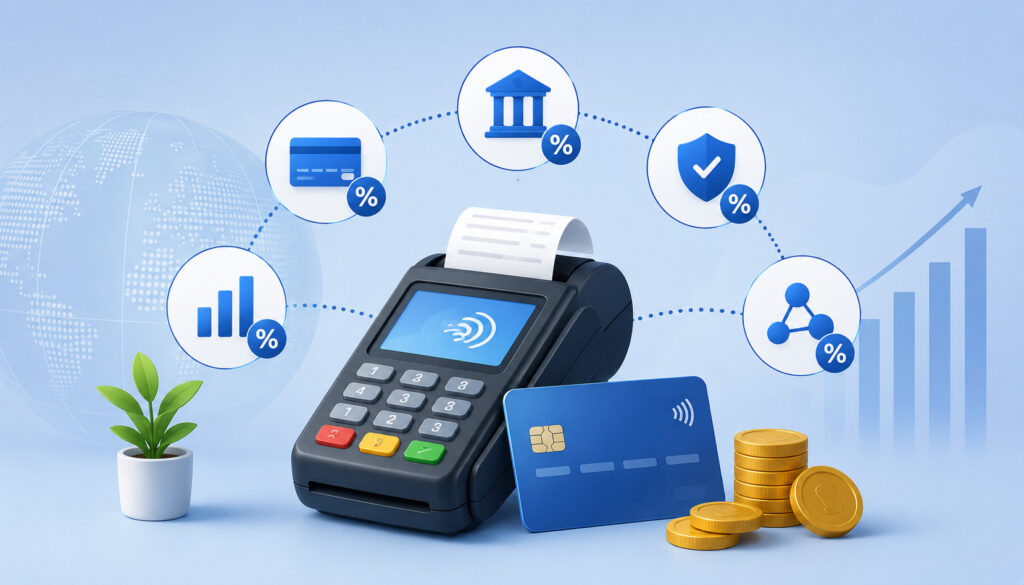
Most credit card processing fees fall into three broad categories: interchange fees, assessment fees, and processor markup. These categories are important because they help businesses understand which costs are generally set by networks or banks and which costs are controlled by the payment processor or merchant services provider.
Interchange fees are often the largest component of card processing fees. They vary based on factors such as card type, transaction method, card-present or card-not-present status, business category, ticket size, cardholder rewards, debit or credit status, and whether the transaction includes the required data.
Assessment fees are network-related fees. They are typically smaller than interchange fees but still affect total cost. Depending on the statement format, assessment fees may appear as separate merchant statement fees or may be bundled into a broader discount rate.
Processor markup is the provider’s portion of the cost. This may include percentage markup, per-transaction fees, monthly fees, gateway fees, statement fees, batch fees, PCI-related fees, equipment costs, support fees, or other account charges.
Beyond these three categories, businesses may see many specific line items. Common examples include authorization fees, AVS fees, batch fees, monthly minimum fees, PCI compliance fees, PCI non-compliance fees, chargeback fees, retrieval fees, equipment fees, refund fees, and early termination fees.
Interchange Fees Explained
Interchange fees are charges associated with card transactions that are generally paid through the payment chain to the cardholder’s issuing bank. They are a core part of credit card transaction fees and often represent a large share of total merchant processing fees.
Interchange exists because issuing banks take on responsibilities such as approving transactions, funding cardholder purchases before repayment, managing fraud risk, maintaining cardholder accounts, and supporting rewards or benefits tied to certain cards.
Interchange fees are not the same for every transaction. A dipped or tapped in-person transaction may carry a different cost than a keyed online transaction.
A standard consumer card may price differently than a rewards card, premium card, business card, or corporate card. Debit card processing fees may differ from credit card fees, and PIN debit may price differently than signature debit.
Risk also matters. Card-present fees are often lower than card-not-present fees because chip, contactless, and secure POS transactions provide stronger evidence that the card was used at the point of sale. Ecommerce payment fees, invoice payments, recurring billing, and keyed transactions may involve greater fraud and chargeback exposure.
Data quality can also affect interchange. Some business-to-business transactions may require additional transaction data to qualify for better categories. Missing or incomplete data may lead to higher costs.
For readers who want a broader introduction to processing cost categories, this guide on payment processing costs and fee structures provides helpful context.
Assessment Fees Explained
Assessment fees are card network fees connected to the use of the card payment system. While interchange fees are generally associated with the issuing bank side, assessment fees are tied to the network infrastructure, rules, and services that help card transactions move between the merchant side and the cardholder side.
Assessment fees may be charged as a small percentage of card volume, a per-item charge, or another network-related cost. They may vary by transaction type, card brand category, cross-border status, authorization activity, settlement activity, or other network rules.
On a merchant statement, assessment fees may appear separately under network fees, dues and assessments, access fees, brand fees, or similar labels. In other cases, they may be bundled into the discount rate, making them less visible.
Businesses sometimes overlook assessment fees because they are usually smaller than interchange. However, they still affect the total cost of accepting cards, especially for businesses with high monthly volume.
Assessment fees are also important when comparing pricing models. In an interchange-plus pricing model, assessments are usually shown more clearly. In flat-rate pricing or blended pricing, they may be included in the overall rate. In tiered pricing, they may be hidden within qualified, mid-qualified, or non-qualified categories.
Processor Markup Explained
Processor markup is the amount charged by the payment processor, merchant account provider, or payment services provider above underlying interchange and assessment costs. This markup pays for the services that allow the business to accept, manage, and reconcile card payments.
Processor markup can appear in several ways. Some providers charge a percentage markup over interchange. Others charge a per-transaction fee. Some charge monthly fees, statement fees, gateway fees, PCI compliance fees, batch fees, support fees, reporting fees, equipment fees, or software-related fees.
In flat-rate pricing, processor markup is usually blended into one simple rate. That may make billing easier to understand, but it can also make it harder to see the underlying cost components. In interchange-plus pricing, processor markup is generally more visible because interchange, assessments, and markup are separated.
Processor markup is one of the areas businesses can review closely when comparing merchant account fees. Underlying interchange and assessment fees are less flexible, but provider-level pricing, monthly charges, gateway fees, and service fees may vary.
That does not mean the lowest markup is always the best choice. A business should also consider statement clarity, support quality, uptime, reporting tools, fraud controls, integration needs, settlement timing, chargeback support, payment security, and contract terms.
A low advertised rate may become expensive if it is paired with high monthly minimum fees, unclear tiered pricing, expensive equipment leases, or unexpected non-compliance charges.
Common Credit Card Merchant Fees to Know

Credit card merchant fees can include many line items. Some apply to almost every account, while others apply only in certain situations.
Transaction fees are per-item charges applied when a payment is authorized, captured, refunded, or otherwise processed. Authorization fees may apply each time a transaction is sent for approval, even if the transaction does not settle.
Batch fees may apply when a business closes a batch of transactions for settlement. Statement fees may cover monthly reporting. Monthly fees may cover account maintenance, support, or platform access. Monthly minimum fees may apply if the account does not generate a required amount of processing fees.
Gateway fees are common for ecommerce, invoices, virtual terminals, and recurring billing. AVS fees may apply when address verification is used to help confirm cardholder billing details. PCI compliance fees may support security validation tools, while PCI non-compliance fees may apply if required security steps are not completed.
Chargeback fees apply when a cardholder disputes a transaction. Retrieval fees may apply when documentation is requested before or during a dispute process. Refund fees may apply when a customer is refunded, depending on provider policy.
Equipment fees may include terminal purchases, rentals, leases, replacement costs, or software-connected POS charges. Early termination fees may apply if a business cancels before the contract term ends.
Credit Card Processing Fees Table
The table below summarizes common credit card processing fees and what businesses should review when they appear on a merchant statement.
| Fee Type | What It Means | When It May Apply | What Businesses Should Review |
| Interchange fees | Underlying transaction costs connected to card type, risk, and issuing side rules | Most credit and debit card transactions | Whether card mix, transaction method, or data quality is affecting cost |
| Assessment fees | Network-related charges connected to card payment system access | Most card transactions | Whether they are shown separately or bundled into the discount rate |
| Processor markup | Provider-level pricing above interchange and assessments | All pricing models, though visibility varies | Percentage markup, per-item fees, and monthly charges |
| Transaction fees | Per-item charges for processing activity | Authorizations, captures, refunds, or other transaction events | Whether fees apply to approved, declined, refunded, or voided transactions |
| Authorization fees | Charges for sending transactions for approval | POS, ecommerce, keyed, mobile, or recurring transactions | Whether declined transactions also create costs |
| Gateway fees | Charges for online payment gateway access | Ecommerce, invoices, virtual terminals, recurring billing | Monthly gateway cost, per-transaction gateway cost, and integration needs |
| PCI compliance fees | Fees related to payment security tools or validation | Merchant accounts that require PCI validation support | What services are included and what actions are required |
| PCI non-compliance fees | Fees charged when security validation is incomplete | When required PCI steps are missed | How to remove the fee and restore compliant status |
| Chargeback fees | Fees tied to customer disputes | Disputed transactions | Chargeback volume, response process, documentation, and prevention tools |
| Batch fees | Fees for closing and submitting transactions for settlement | POS or terminal batches | Whether batching is automatic and whether staff close batches on time |
| Statement fees | Fees for monthly statements or reporting | Monthly billing cycle | Whether electronic statements can reduce or eliminate the fee |
| Monthly minimum fees | Minimum fee threshold required by the provider | Low-volume months | Whether the minimum is reasonable for seasonal or startup volume |
| Equipment fees | Terminal, reader, POS, or device-related costs | In-person payment acceptance | Purchase, rental, lease, replacement, and cancellation terms |
| Refund fees | Fees related to refunded transactions | Customer refunds | Whether original processing fees are returned or retained |
This table is not a substitute for reading the actual agreement. Fee names vary by provider, and some charges may be bundled. Businesses should review the full fee schedule, statement format, contract terms, and support documentation before comparing costs.
Credit Card Processing Pricing Models
Pricing models determine how credit card processing fees are presented and billed. Two businesses can process the same card transaction and see very different statement formats depending on their pricing structure.
The most common models include flat-rate pricing, interchange-plus pricing, tiered pricing, subscription pricing, and blended pricing. Each model has advantages and tradeoffs. The right fit depends on transaction volume, average ticket size, sales channel, business type, statement review needs, and tolerance for complexity.
Pricing transparency matters because businesses need to understand what they are paying for. A model that looks simple may bundle many costs into one rate. A model that looks detailed may be more accurate but require more statement review.
No pricing model is automatically best for every business. A startup with low volume may value simplicity. A growing retailer may need clearer reporting. An ecommerce seller may focus on gateway fees, fraud tools, and chargeback costs. A finance team may prefer itemized statements that show interchange, assessment fees, and processor markup.
For a broader overview of merchant services tools, including processing, POS, and gateway functions, this resource on merchant services features and business payment tools may be useful.
Flat-Rate Pricing
Flat-rate pricing charges the same general rate for many transactions. For example, a business may pay one rate for card-present transactions and another rate for card-not-present transactions. The rate usually includes interchange fees, assessment fees, and processor markup in one bundled price.
The main advantage is simplicity. Newer businesses, lower-volume sellers, mobile vendors, and small service providers may appreciate predictable pricing and easy-to-read statements. Flat-rate pricing can also reduce confusion when a business does not yet have enough volume to justify detailed statement analysis.
The tradeoff is reduced visibility. Because underlying costs are bundled, it may be harder to see whether rewards card fees, business card fees, debit card processing fees, or transaction method changes are affecting cost. As volume grows, a flat rate may or may not remain competitive.
Businesses using flat-rate pricing should still calculate effective rate and review monthly totals. Simplicity is helpful, but it should not replace cost awareness.
Interchange-Plus Pricing
Interchange-plus pricing separates the major cost components. The business pays the actual interchange category, applicable assessment fees, and a clearly stated processor markup. The markup may be shown as a percentage, a per-transaction amount, or both.
This model can make merchant processing fees easier to analyze because the statement shows more detail. Businesses can see how much cost comes from interchange, how much comes from assessments, and how much comes from provider markup.
Interchange-plus pricing may be especially useful for established businesses, higher-volume merchants, finance teams, and companies that want more transparency. It can also help identify changes caused by card mix, transaction method, or downgrades.
The tradeoff is complexity. Statements may be longer, and the business may need to understand transaction categories. Still, for many businesses, transparency is worth the extra detail.
Tiered Pricing
Tiered pricing groups transactions into categories such as qualified, mid-qualified, and non-qualified. The provider decides how different transactions are assigned to each tier based on card type, transaction method, data quality, risk, or other rules.
Qualified transactions usually have the lowest rate. Mid-qualified and non-qualified transactions cost more. A business may see higher costs if many transactions downgrade into more expensive tiers.
The challenge is that tiered pricing can be difficult to evaluate. The advertised qualified rate may apply only to a limited portion of transactions. Rewards cards, business cards, keyed transactions, card-not-present sales, or missing data may fall into higher-cost categories.
Businesses using tiered pricing should review how many transactions fall into each tier and whether downgrade costs are raising the effective rate. They should also ask for a written explanation of qualification rules.
Card-Present vs Card-Not-Present Fees
Card-present transactions occur when the customer’s card or device is physically used at the point of sale. This includes EMV chip cards, contactless cards, mobile wallets, and properly used POS terminals.
Card-not-present transactions occur when the card is not physically presented, such as ecommerce checkout, keyed phone orders, invoices, virtual terminals, and recurring billing.
Fees often differ because risk differs. A chip or contactless in-person transaction gives stronger evidence that the payment credential was present. A keyed transaction or online order may carry more fraud exposure because the business cannot physically inspect the card or verify the customer in the same way.
Card-not-present fees may include ecommerce payment fees, gateway fees, AVS fees, fraud screening costs, tokenization services, recurring billing fees, and higher chargeback exposure. These costs do not mean online sales are bad. They simply reflect the technology and risk controls required for remote payments.
Security practices matter. AVS, CVV checks, tokenization, secure checkout forms, fraud filters, strong refund policies, and clear billing descriptors can help reduce disputes and improve payment security.
Businesses should also follow applicable payment data standards. The payment data security standards maintained by the industry standards body provide important guidance for organizations that handle cardholder data.
Credit Card vs Debit Card Processing Fees
Credit card and debit card processing fees may differ because the payment products work differently. A credit card transaction extends credit to the cardholder, while a debit card transaction draws from a deposit account. That difference can affect risk, routing, network rules, interchange categories, and transaction costs.
Debit card processing fees may be lower in some situations, but not always. Costs can vary based on whether the debit transaction is PIN debit or signature debit, whether the card is regulated or non-regulated, which network routes the transaction, ticket size, and how the transaction is accepted.
Credit card fees may be higher when the card includes rewards, premium benefits, business features, or corporate purchasing functionality. Rewards card fees and business card fees may cost more because the underlying interchange category can be higher.
For merchants, the practical takeaway is to review actual statements rather than assume all debit cards are cheap or all credit cards are expensive. A small-ticket debit transaction may price differently than a large-ticket transaction. PIN debit may make sense in some retail environments, while online debit transactions may follow different rules.
Debit routing rules and regulated debit topics are technical, but they can affect merchant costs. Businesses that want to understand debit card routing requirements can review the electronic debit transaction rules published in federal regulations.
How Business Type Can Affect Credit Card Fees
Business type can influence credit card merchant fees because payment risk, transaction size, sales channel, delivery timing, refund patterns, and chargeback exposure vary by industry.
A retail store with mostly card-present transactions may see a different cost profile than an ecommerce seller with national shipping, online fraud screening, and card-not-present transactions.
A restaurant may have tips, adjustments, table-service workflows, and POS payment fees. A professional service provider may use invoices, stored cards, or recurring billing. A subscription business may deal with declined recurring payments, account updater tools, refunds, and cancellation disputes.
The merchant category can also matter. Some industries are considered higher risk because of delayed delivery, future services, higher chargeback rates, regulated products, large ticket sizes, trial offers, or complex refund expectations. Higher-risk classification may affect underwriting, reserves, rolling holds, pricing, or account terms.
Average ticket size matters too. A business with many small transactions may be more affected by per-transaction fees. A business with large tickets may be more affected by percentage-based fees. Seasonal businesses may need to watch monthly minimum fees during slower months.
Transaction volume can influence pricing options. Higher-volume businesses may have more room to compare pricing models, negotiate processor markup, or request statement reviews. Lower-volume businesses may value simple billing and low fixed monthly costs.
No business should assume that another merchant’s rate will apply to them. The better approach is to review transaction mix, risk profile, sales channels, contract terms, and total monthly cost.
How to Calculate Your Effective Rate
Effective rate is one of the most useful ways to understand total credit card processing fees. It shows the percentage of card sales paid in processing costs after all fees are included.
The formula is simple:
Effective Rate = Total Processing Fees ÷ Total Card Processing Volume
For example, suppose a business processes $50,000 in card sales for the month and pays $1,600 in total processing fees. The effective rate is:
$1,600 ÷ $50,000 = 3.2%
This number includes more than the discount rate. It can include interchange fees, assessment fees, processor markup, monthly fees, gateway fees, PCI compliance fees, statement fees, batch fees, authorization fees, and other merchant account fees.
Effective rate is helpful because it gives a broader view of total cost. It can also help businesses compare monthly trends. If the effective rate increases, the business can review whether sales moved from card-present to card-not-present, whether rewards card volume increased, whether chargebacks occurred, whether monthly fees changed, or whether new services were added.
Effective rate is not the only metric. A business should also consider average ticket size, transaction count, card mix, sales channel, pricing model, refund volume, and chargebacks. A business with many small transactions may naturally have a higher effective rate because per-item fees represent a larger share of each sale.
Why Credit Card Processing Fees May Change
Credit card processing fees can change even when a business keeps the same provider. Sometimes the cause is a pricing update. Other times, the business’s transaction mix changes.
A common reason is card mix. If more customers use rewards cards, premium cards, business cards, or corporate cards, interchange fees may increase. If more sales shift online or to invoices, card-not-present fees may increase. If more customers use debit cards, the average cost may move differently depending on routing and transaction size.
Fees may also change because of chargebacks, retrieval requests, refunds, PCI non-compliance, added gateway tools, new POS software, equipment replacement, or monthly service changes. A business that forgets to complete PCI compliance validation may see non-compliance fees until the issue is resolved.
Growth can also change costs. Higher transaction volume may increase total fees even if the effective rate stays stable. On the other hand, higher volume may create an opportunity to review pricing or move to a more transparent model.
Statement format can make changes harder to spot. A fee may be renamed, moved to a different section, or bundled into a broader discount line. That is why businesses should compare statements month by month and ask for written clarification when something changes.
How Credit Card Fees Appear on Merchant Statements
Merchant statements can be confusing because providers organize fees differently. Some statements are detailed and separate interchange, assessment fees, processor markup, monthly fees, gateway fees, and chargeback fees. Others use bundled categories that make costs harder to trace.
A typical statement may show gross card sales, refunds, chargebacks, net sales, transaction count, batch totals, discount fees, authorization fees, network fees, monthly service charges, PCI fees, gateway fees, equipment fees, and deposit summaries.
Some providers deduct fees daily before deposits are made. Others deposit gross sales and bill fees at the end of the month. The billing method affects reconciliation. If deposits are net of fees, the amount in the bank account may not match gross sales. If fees are billed monthly, deposits may appear larger during the month but a separate fee debit may occur later.
Merchant statement fees may also show interchange categories. These categories can identify whether transactions were card-present, card-not-present, rewards, business, debit, keyed, ecommerce, or downgraded.
Businesses should reconcile statements with POS reports, ecommerce reports, accounting records, refund logs, and bank deposits. This helps identify missing deposits, duplicate charges, unexpected chargebacks, or fee changes.
Red Flags to Watch for in Credit Card Processing Fees
Some fee changes are normal. Others deserve closer review. A red flag does not always mean something is wrong, but it does mean the business should ask questions.
Unexplained new fees are one warning sign. If a statement suddenly includes a new monthly fee, support fee, non-compliance fee, equipment charge, or service fee, ask what it is and where it appears in the agreement.
High non-qualified fees under tiered pricing can also be a concern. If many transactions are downgraded, the advertised rate may not reflect what the business actually pays. Ask how transactions are categorized and whether better data entry, batching, or transaction methods can reduce downgrades.
Unexpected PCI non-compliance fees should be addressed quickly. These fees may continue monthly until required validation steps are completed. Businesses should also be cautious with expensive equipment leases, especially long-term leases that cost far more than buying equipment.
Duplicate charges, unclear gateway fees, excessive chargeback fees, confusing cancellation terms, and fees that do not match the written agreement should also be reviewed.
A statement that is impossible to understand is another practical concern. Businesses need enough clarity to reconcile deposits, calculate effective rate, and identify changes.
How to Reduce or Better Manage Credit Card Processing Costs
Businesses may not be able to eliminate credit card processing fees, but they can manage them more effectively. The first step is reviewing statements every month. Look at total fees, effective rate, transaction count, card volume, chargebacks, refunds, and new line items.
Reducing chargebacks can also help. Use clear billing descriptors, accurate product descriptions, signed receipts where appropriate, delivery confirmation, responsive customer service, and clear refund policies. For online payments, use fraud filters, AVS, CVV checks, tokenization, and secure checkout tools.
Keep PCI compliance current. Completing required validation steps can help avoid PCI non-compliance fees and strengthen payment security. Businesses should also train staff to use chip and contactless methods instead of keying cards when possible.
Enter complete transaction data, especially for business-to-business sales when additional data may help transactions qualify correctly. Batch transactions on time. Review equipment costs and avoid paying for devices or software that are no longer used.
Compare pricing models periodically, but do not focus only on the lowest advertised rate. Ask for a full fee schedule, sample statement, contract terms, gateway costs, chargeback fees, monthly minimums, and cancellation terms.
For additional context on secure in-person transactions, this guide to chip and contactless payment risk explains why proper terminal use matters.
Credit Card Processing Pricing Model Comparison Table
The table below compares common pricing models and what businesses should consider before choosing one.
| Pricing Model | How It Works | Potential Advantages | Important Considerations |
| Flat-rate pricing | Bundles many costs into one predictable rate | Simple statements and easier forecasting | Less visibility into interchange, assessments, and processor markup |
| Interchange-plus pricing | Passes through interchange and assessments, then adds stated markup | More transparent and easier to analyze | Statements may be more detailed and require review |
| Tiered pricing | Groups transactions into pricing tiers | May look simple at first | Downgrades can increase costs and reduce transparency |
| Subscription pricing | Charges a monthly membership plus transaction-level costs | Can be useful for some higher-volume businesses | Monthly fee must be justified by actual savings |
| Blended pricing | Combines multiple costs into broader bundled rates | Easier to read than fully itemized billing | Harder to identify underlying cost changes |
A pricing model should match the business’s needs. A startup may prefer simple pricing and minimal fixed costs. A growing ecommerce business may need gateway transparency and chargeback reporting. A retail store may care more about POS payment fees, equipment terms, and card-present transaction costs.
The best comparison includes total monthly cost, effective rate, fee transparency, support, security tools, settlement timing, contract flexibility, and statement clarity.
Questions to Ask About Credit Card Processing Fees
Before choosing or changing a payment setup, businesses should ask direct questions about credit card processing fees. Written answers are better than verbal summaries because they make later statement review easier.
Useful questions include:
- What pricing model is used?
- Which fees are included, and which fees are separate?
- Are interchange fees and assessment fees shown clearly?
- What processor markup applies?
- Are there monthly fees or monthly minimum fees?
- Are gateway fees separate?
- Are PCI compliance fees charged?
- What happens if PCI validation is not completed?
- What chargeback fees and retrieval fees apply?
- Are refund fees charged?
- Are AVS fees or authorization fees charged separately?
- Are there equipment costs, rentals, or leases?
- Can rates or fees change?
- Are there contract cancellation fees?
- How are card-present and card-not-present fees handled?
- How easy is it to read the monthly statement?
- Are deposits made gross or net of fees?
- What reporting tools are available for reconciliation?
These questions help businesses compare total cost, not just a headline rate. They also reveal whether the provider can explain pricing clearly. If a business cannot get a clear fee schedule, it may struggle to understand future statements.
Common Mistakes Businesses Make With Credit Card Fees
One common mistake is focusing only on the lowest advertised rate. A low rate may apply only to certain qualified transactions or may exclude monthly fees, gateway fees, PCI fees, batch fees, statement fees, and other charges.
Another mistake is ignoring the full fee schedule. Businesses should review all recurring fees, transaction fees, equipment costs, chargeback fees, refund policies, cancellation terms, and minimums before making a decision.
Some businesses misunderstand pricing models. Flat-rate pricing may be simple but less detailed. Interchange-plus pricing may be transparent but more complex. Tiered pricing may appear easy but can become expensive if many transactions downgrade.
Not calculating effective rate is another issue. Without effective rate, a business may not know what it actually pays as a percentage of card volume. Effective rate helps compare total cost across months and providers.
Overlooking chargebacks can also be costly. Chargebacks create fees, administrative work, lost revenue risk, and possible account review if dispute levels become too high.
Failing to reconcile deposits is another common problem. Refunds, chargebacks, processing fees, reserves, and settlement timing can all affect deposits.
Finally, some businesses stop reviewing statements after signing. Fees can change, volume can shift, and new line items can appear. Monthly review is the best way to avoid surprises.
Best Practices for Reviewing Credit Card Processing Fees
Good fee management starts with a repeatable review process. Each month, compare total card volume, total fees, transaction count, refunds, chargebacks, deposits, and effective rate.
Look for unusual changes. Did the effective rate increase? Did card-not-present volume rise? Did rewards card or business card activity increase? Did a PCI non-compliance fee appear? Did gateway fees, statement fees, or monthly service charges change?
Reconcile deposits against POS reports, ecommerce reports, invoices, and bank activity. If deposits are net of fees, account for processing costs properly. If fees are billed monthly, make sure the fee debit matches the statement.
Track chargebacks and retrieval requests separately. Review the reason codes, customer communication, fulfillment records, and refund policies. Reducing disputes can help protect revenue and reduce administrative burden.
Keep PCI compliance documentation current. Store agreements, fee schedules, equipment records, gateway settings, and support communications in one place. This helps with accounting, contract review, and future provider comparisons.
Businesses with multiple locations, sales channels, or merchant accounts should compare performance across each setup. A retail location, online store, and invoice workflow may each have different costs and risks.
Best practice is not about chasing the cheapest rate every month. It is about understanding costs, spotting changes early, and making payment decisions with better information.
When to Get Help Understanding Credit Card Merchant Fees
Some merchant statements are complex enough that outside help may be useful. A business may want support from an accountant, financial advisor, payment consultant, or knowledgeable payments professional when fees increase unexpectedly, statements are hard to read, or processing volume becomes significant.
Help may also be useful when a business has recurring chargebacks, multiple locations, ecommerce fraud concerns, complex pricing models, equipment lease questions, contract confusion, or reconciliation issues.
An accountant can help connect merchant statements to bookkeeping, bank deposits, refunds, and sales reports. A payments professional can help explain pricing models, statement categories, interchange downgrades, gateway fees, chargeback fees, and account setup options.
Businesses should avoid relying on guesses when large amounts of money are involved. A small misunderstanding can create ongoing costs. For example, a business may think it has a low rate while paying high non-qualified fees or unnecessary monthly add-ons.
This guide is educational and should not be treated as legal, tax, financial, or compliance advice. If a decision involves contract terms, accounting treatment, tax reporting, security obligations, or regulatory requirements, consult a qualified professional.
What are credit card processing fees?
Credit card processing fees are the costs businesses pay to accept card payments. These fees help cover authorization, routing, settlement, payment security, network access, fraud controls, account support, reporting, and related payment services.
They may include interchange fees, assessment fees, processor markup, transaction fees, monthly fees, gateway fees, PCI compliance fees, chargeback fees, and other charges. The exact fee structure depends on the provider, pricing model, business type, card mix, and sales channel.
Why do businesses pay credit card fees?
Businesses pay credit card fees because accepting cards requires access to payment networks, issuing banks, acquiring banks, processors, gateways, security tools, and settlement systems. These systems allow customers to pay conveniently while helping merchants receive funds.
Fees also support fraud monitoring, dispute handling, reporting, risk controls, and the infrastructure needed to approve or decline transactions quickly. While fees are a cost, card acceptance can also support customer convenience and sales flexibility.
What are credit card merchant fees?
Credit card merchant fees are the charges a business pays through its merchant account or payment processing setup. They may include transaction fees, discount rate charges, processor markup, merchant account fees, gateway fees, batch fees, statement fees, PCI fees, and chargeback-related costs.
The term is often used broadly to describe the total cost of accepting credit card payments. Businesses should review the full statement rather than focusing on one line item.
What is the difference between interchange fees and processor markup?
Interchange fees are underlying transaction costs generally connected to the issuing bank side of a card transaction. They vary based on card type, transaction method, business category, data quality, risk level, and other factors.
Processor markup is the provider’s added charge for processing services. It may appear as a percentage, per-transaction fee, monthly fee, gateway fee, statement fee, or other account charge. Interchange is usually less controllable, while processor markup varies by provider and pricing model.
What are assessment fees?
Assessment fees are network-related charges connected to card payment system access and rules. They are different from interchange fees and processor markup.
Assessment fees may appear separately on merchant statements or may be bundled into a broader discount rate. They are often smaller than interchange fees, but they still contribute to the total cost of card acceptance.
What is an effective rate?
Effective rate is the total processing cost expressed as a percentage of total card sales. To calculate it, divide total processing fees by total card processing volume.
For example, if a business processes $50,000 in card sales and pays $1,600 in total fees, the effective rate is 3.2%. This calculation helps businesses understand total cost after monthly fees, gateway fees, transaction fees, and other charges are included.
Why are online credit card fees different from in-person fees?
Online credit card fees are often different because ecommerce and invoice payments are card-not-present transactions. These transactions can carry higher fraud and chargeback risk because the card is not physically used at a terminal.
Online payments may also require a payment gateway, AVS checks, CVV verification, tokenization, fraud filters, hosted checkout tools, and recurring billing features. These services can add cost but also help protect transactions.
Are debit card fees lower than credit card fees?
Debit card processing fees may be lower in some cases, but not always. Costs depend on card type, transaction method, routing, PIN debit or signature debit, regulated or non-regulated status, ticket size, and network rules.
Businesses should review actual merchant statements instead of assuming all debit card transactions are less expensive. The real cost depends on how the transaction is routed and processed.
Can credit card processing fees be negotiated?
Some parts of credit card processing fees may be negotiable, especially processor markup, monthly fees, gateway fees, statement fees, equipment fees, and certain service charges. Interchange fees and assessment fees are generally less flexible because they are tied to underlying payment system rules.
Businesses with higher volume, strong processing history, low chargeback rates, and clear transaction data may have more room to compare options. However, the goal should be total value and transparency, not simply the lowest quoted rate.
Why did my merchant processing fees increase?
Merchant processing fees may increase because of changes in card mix, more card-not-present transactions, increased rewards card volume, added gateway services, PCI non-compliance fees, chargebacks, refund activity, equipment costs, contract updates, or pricing changes.
The best way to identify the cause is to compare current and prior statements. Look at effective rate, total fees, transaction count, card categories, chargebacks, monthly charges, and new line items.
How can businesses reduce credit card processing costs?
Businesses can better manage card processing fees by reviewing statements monthly, calculating effective rate, reducing chargebacks, completing PCI compliance steps, using secure payment methods, avoiding unnecessary keyed transactions, entering complete transaction data, batching on time, and reviewing equipment costs.
They should also compare pricing models, ask for a full fee schedule, and request written explanations of unclear charges. Cost control comes from understanding the full processing setup, not chasing one advertised rate.
Conclusion
Credit card processing fees can seem complicated because they include several cost components. Interchange fees, assessment fees, processor markup, transaction fees, monthly fees, gateway fees, PCI-related costs, chargeback fees, retrieval fees, authorization fees, AVS fees, batch fees, statement fees, and equipment costs can all affect what a business pays.
A practical approach is to look beyond the advertised rate. Review the full merchant statement, calculate effective rate, understand the pricing model, monitor changes in card mix, reconcile deposits, keep PCI compliance current, and ask informed questions before choosing or changing a payment setup.
Businesses that understand credit card processing fees are better prepared to protect margins, manage cash flow, compare payment options, and avoid unexpected costs. The right payment setup is not just about price. It is about clarity, security, reliability, and a fee structure the business can understand and manage over time.