
By Robert Crossman October 5, 2026
Processor requesting documents merchant account review: if this is the situation you are dealing with, verify the request, identify the real deadline, gather complete current records, explain unusual activity, and submit everything through the processor’s authorized secure channel. If one document is unavailable, contact the analyst promptly rather than ignoring the request.
If You Received a Risk-Team Email Today, Do These 7 Things
- Verify the sender and request: Confirm the email through your authenticated processor portal, an established account representative, or a telephone number you already know is legitimate.
- Record the stated deadline: Do not assume every processor gives merchants the same amount of time.
- Turn the request into a checklist: Separate bank statements, invoices, licenses, ownership records, transaction records, and fulfillment documents into individual items.
- Clarify unclear requirements: Ask which months, transaction samples, document format, or business entity the analyst wants.
- Gather complete and legible documents: Avoid cropped screenshots when full statements or complete records were requested.
- Explain unusual activity upfront: A short factual explanation of a seasonal increase, unusually large contract, new supplier, delayed shipment, ownership change, or new bank account can prevent unnecessary follow-up.
- Submit securely and keep proof: Save the upload confirmation, document index, correspondence, and final review response.
An unexpected underwriting document request should be taken seriously, but it should also be verified before sensitive records are transmitted. Do not email passports, Social Security numbers, complete bank credentials, identity documents, or unnecessary customer information to an unverified address simply because the message uses your processor’s name.
Why an Established Merchant Account Can Suddenly Go Back Into Review

A processor requesting documents merchant account review can occur even when the business has processed successfully for years. Initial merchant-account approval does not necessarily mean the acquiring relationship will never be evaluated again.
Processors and acquiring institutions monitor whether actual activity continues to match the business profile that was originally approved. A merchant account risk review can therefore arise when something material changes or when monitoring identifies information that needs clarification.
Common triggers can include:
- substantial increases in monthly processing volume;
- higher average or maximum transaction values;
- unusually rapid growth;
- refund increases;
- higher dispute or chargeback activity;
- fraud indicators;
- transaction patterns outside the original underwriting profile;
- new products or services;
- a new ecommerce or card-not-present channel;
- changes in fulfillment methods;
- longer delivery windows;
- greater future-delivery exposure;
- changes in business ownership;
- changes in legal-entity information;
- a new DBA;
- new locations;
- changes to the settlement bank account;
- licensing changes;
- materially different website content;
- unusual cross-border activity;
- financial-condition concerns; or
- information identified through merchant monitoring.
A merchant that was originally expected to process $60,000 per month but begins processing substantially more during a legitimate growth period is not automatically doing anything wrong.
The increase can still create reasonable questions about inventory, supplier capacity, customer demand, refund exposure, delivery capability, and whether the original underwriting profile remains accurate.
Business-identity changes can be particularly important. A new owner, entity, DBA, website, settlement account, or material product change can alter the information on which the original approval was based.
Merchants making these changes should understand how changes to a legal entity, ownership, DBA, or bank account can affect an existing merchant account rather than assuming every update is merely administrative.
A Review Does Not Automatically Mean the Processor Plans to Close You
Most merchants understandably become concerned when a payment processor risk department asks for additional records.
A request for updated merchant account documentation does not, by itself, prove that termination is being considered. Many reviews are simply information-gathering exercises designed to reconcile current activity with the existing merchant profile.
The situation deserves closer attention when the processor compliance review is accompanied by a funding hold, reserve discussion, significantly reduced processing limits, repeated questions about undelivered orders, or notice that the account is undergoing enhanced review.
Even then, no single indicator guarantees termination.
KYC/CDD Refreshes Are Risk-Based, Not a Universal Calendar Rule
A processor requesting documents merchant account review may be described internally as a KYC review, CDD update, periodic merchant account review, merchant underwriting review, acquiring bank review, compliance refresh, or re-underwriting.
Those terms should not automatically be treated as interchangeable federal requirements.
FinCEN’s Customer Due Diligence Rule applies to covered financial institutions. That does not mean every processor document request received by a merchant is itself a direct FinCEN requirement imposed on that merchant.
FinCEN’s current Customer Due Diligence FAQs reflect the 2026 changes to beneficial-ownership procedures. FIN-2026-R001 provides exceptive relief that allows covered financial institutions, in qualifying circumstances, to avoid identifying and verifying a legal-entity customer’s beneficial owners every time the same customer opens another account.
Instead, identification and verification may occur at the first account opening, when information calls previous beneficial-ownership information into question, or when risk-based ongoing CDD procedures require a beneficial ownership update.
A bank or other covered institution may still adopt more extensive procedures based on its own risk program.
The FFIEC BSA/AML Customer Due Diligence manual makes another critical distinction: maintaining and updating customer information is risk-based, and the need to update information is generally event-driven.
FFIEC does not establish a rule requiring every customer to undergo a refresh every six, 12, 18, or 24 months.
A financial institution can nevertheless adopt risk-based periodic procedures of its own. As a result, a periodic merchant account review may be legitimate even though no federal rule creates one universal merchant-review calendar.
This is also why a KYC refresh merchant account request should not automatically be interpreted as evidence that something is wrong. A provider may need updated information because ownership changed, previously collected information has become questionable, transaction activity changed, or its own risk-based procedures call for a review.
The Corporate Transparency Act beneficial-ownership reporting system is separate from a financial institution’s CDD obligations. A merchant should not assume that filing or exemption under one system eliminates every information request that can arise in an acquiring or banking relationship.
Processor Requesting Documents Merchant Account Review: What They Usually Want
A processor requesting documents merchant account review usually focuses on records that help answer one or more specific risk questions. The processor does not necessarily need every document listed below.
Many of these records are also used during initial underwriting because they help verify identity, operations, financial condition, and the business model. Merchants can see the broader context in the explanation of documents commonly used during merchant account approval.
| Document | What the Risk Team May Be Checking | What to Review Before Sending |
| Business bank statements | Account ownership, financial activity, liquidity, operating consistency | Correct entity, requested period, complete pages |
| Supplier/vendor invoices | Product sourcing and inventory legitimacy | Supplier name, dates, products and totals |
| Inventory records | Whether sales are supported by actual merchandise | Inventory matches products being sold |
| Customer invoices/orders | Whether card transactions correspond to genuine sales | Amounts, dates and products reconcile |
| Shipping/tracking records | Whether orders are progressing toward fulfillment | Tracking relates to the sampled orders |
| Proof of delivery | Whether completed transactions were fulfilled | Delivery details match order details |
| Service contracts | Evidence for businesses without physical inventory | Scope, customer, dates and deliverables |
| Business licenses | Legal authority to conduct licensed activity | Entity, jurisdiction and expiration date |
| Professional licenses | Professional authorization where required | Name, status and expiration |
| Formation records | Legal existence and business identity | Names and addresses are consistent |
| Ownership/control records | Who owns or controls the merchant | Information is current |
| Financial statements | Financial capacity or potential exposure | Correct business and reporting period |
| Processing statements | Volume, disputes, refunds and transaction history | Correct MID and requested dates |
| Refund/cancellation policy | Consumer-risk and dispute-management practices | Policy matches actual practice |
| Website information | Products, pricing, policies and delivery representations | Website matches approved business model |
| Large-transaction support | Commercial basis for unusual transaction amounts | Contract, invoice and fulfillment evidence reconcile |
There is no industry-wide rule that every processor always needs three bank statements, six months of invoices, or a fixed number of customer orders.
If the underwriting document request does not specify a date range, ask.
What Bank Statements Are Actually Proving
During a processor requesting documents merchant account review, bank statements may help answer much more than whether a merchant owns a bank account.
The analyst may be looking for consistency between the business’s legal name and the account-holder name. The payment processor risk department may also evaluate deposits, operating activity, returned items, negative balances, cash-flow patterns, account stability, and apparent ability to withstand refunds or disputes.
The importance of individual factors depends on the purpose of the review.
For example, a merchant with significant future-delivery obligations can create different exposure from a business that delivers products immediately. If customers have paid for goods that will not ship for several months, financial capacity may be relevant because refunds or disputes could arise before fulfillment is complete.
There is no universal safe bank balance that guarantees approval.
A merchant account risk review should therefore not be approached by asking, “How much money do I need in the account?” The better question is, “What concern is the analyst trying to evaluate, and do these statements provide enough evidence to address it?”
Why They Ask for Supplier Invoices and Fulfillment Evidence
A processor requesting documents merchant account review often includes supplier records when the analyst needs to understand whether processing activity is supported by legitimate business operations.
Supplier invoices can help establish that:
- products are genuinely sourced;
- the business purchased enough inventory to support higher sales;
- an unusual increase in processing volume has a commercial explanation;
- the merchant is selling products consistent with its approved business model; and
- the business has a credible path to fulfilling customer orders.
The need for invoices and fulfillment proof for processor review becomes especially important when substantial customer money is collected before delivery.
Fulfillment verification can include shipping records, tracking information, delivery confirmations, warehouse documentation, customer-order records, or other evidence connecting a processed payment to a real order.
For service businesses, invoices and fulfillment proof for processor review may look different. Appropriate evidence might include:
- signed customer contracts;
- purchase orders;
- project schedules;
- appointment records;
- work orders;
- milestone records;
- customer acceptance records;
- proof of completed services; or
- other records appropriate to the business model.
Do not create an artificial supplier trail merely because an analyst asks for “supplier invoices.”
If the company legitimately does not purchase physical inventory, explain how it fulfills customer obligations and ask which alternative documentation will satisfy the request.
How Fast Should You Respond to an Underwriting Document Request?
For a processor requesting documents merchant account review, use the deadline stated in the actual request.
There is no universal merchant-document deadline that applies to every processor, acquiring bank, risk department, and merchant account.
The deadline may come from:
- the processor’s written request;
- the merchant agreement;
- an acquiring-bank instruction;
- the provider’s risk procedures; or
- circumstances surrounding a specific review.
Do not convert an acquirer-to-network deadline into a merchant deadline merely because both involve document requests.
If the full package will take time to assemble, acknowledging the underwriting document request promptly is usually operationally sensible.
A simple response might say:
Received. We are compiling the requested documents and expect to submit them by October 6, 2026. Please confirm whether you need any additional records, a specific statement period, or documentation relating to particular transactions.
That is a practical communication example, not mandatory legal wording.
Possible Review Escalation
| Review Stage | What May Be Happening | Best Merchant Response |
| Initial information request | Analyst needs additional or updated information | Confirm receipt and build the checklist |
| Reminder | Requested records remain outstanding | Identify what is missing and provide a realistic date |
| Clarification request | Submitted material created new questions | Reconcile discrepancies directly |
| Elevated review | Account is receiving greater scrutiny | Ask whether processing or funding is affected |
| Reserve review | Processor may be evaluating potential exposure | Ask what agreement provision applies |
| Funding control | Deposits may be delayed or restricted where permitted | Obtain written status and affected amounts |
| Processing restriction | Account activity may be limited | Escalate through authorized contacts |
| Termination consideration | Provider may decide the relationship is no longer acceptable | Preserve records and request written instructions |
This is not an automatic sequence.
Different processors may combine stages, skip stages, or resolve the merchant account risk review immediately after receiving satisfactory evidence.
Ignoring an underwriting document request can make resolution harder because the analyst must evaluate the account with incomplete information.
It does not mean the merchant is automatically reported to Mastercard MATCH Pro.
Mastercard’s current Security Rules and Procedures link MATCH Pro reporting to merchant termination and specified reason-code conditions. A late response to a document request is not, by itself, a universal MATCH Pro reason.
How to Package Documents So the Analyst Does Not Come Back Three Times
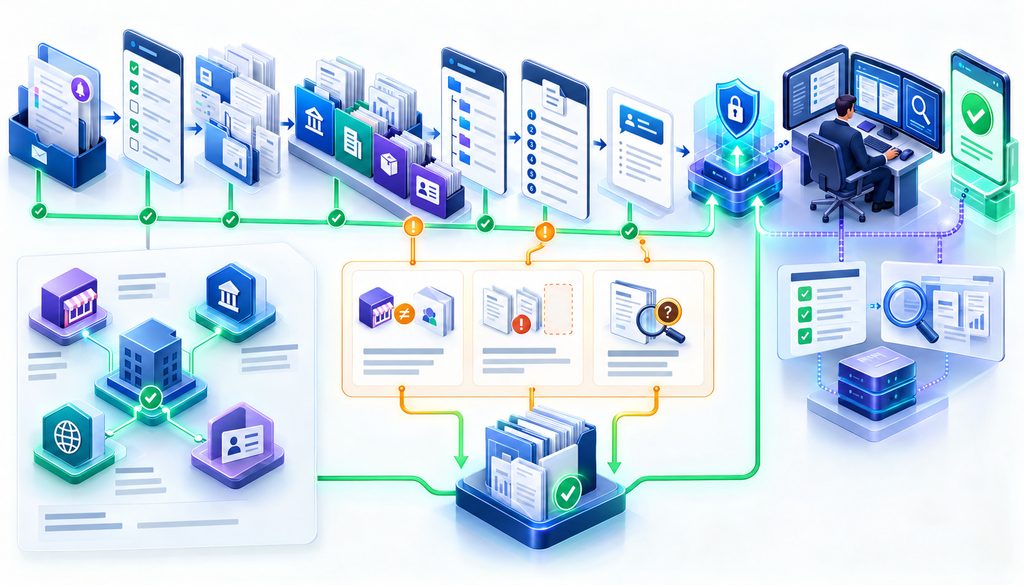
A processor requesting documents merchant account review is easier to close when everything is submitted as one organized evidence package instead of a collection of unexplained attachments.
Use this workflow:
- Read the request line by line. Do not rely on memory.
- Create one checklist item per request.
- Identify the date range for every item.
- Match each requested item to one clearly named file.
- Use complete records where complete records were requested.
- Keep multi-page statements in their original order.
- Use descriptive filenames.
- Create a one-page submission index.
- Reconcile legal name, DBA, bank-account name and website.
- Check which MID the evidence relates to.
- Explain material anomalies separately.
- Identify one contact person for questions.
- Use the approved secure upload channel.
- Retain proof of submission.
- Ask for written confirmation when the review closes.
A file such as:
ABC-Company_Bank-Statement_2026-09.pdf
is much easier for an analyst to work with than:
scan0042.pdf
If a business operates several processing accounts, brands, locations, or channels, make sure the merchant account documentation corresponds to the MID actually being reviewed.
A correctly documented single-MID or multi-MID structure can make it easier to trace transaction activity, deposits, disputes, reserves, and fulfillment records to the correct processing relationship.
Sample Cover Note
Merchant legal name: ABC Company LLC
DBA: ABC Retail
Review reference: [reference number]
Attached are the documents requested for the current merchant account risk review:
- Business bank statements for the requested period
- Supplier invoices supporting recent inventory purchases
- Customer-order samples and corresponding fulfillment records
- Current business license
September processing increased because of our normal seasonal sales cycle. Supplier invoices supporting the additional inventory are included in Item 2.
One requested document is unavailable for the reason explained in the attached note. Substitute documentation has been included. Please confirm whether this is sufficient or whether another record is required.
Please confirm receipt and advise if any requested item remains outstanding.
Keep unnecessary sensitive information out of the cover note.
Do not include passwords, complete payment-card information, unnecessary Social Security numbers, or confidential customer data merely to make the package appear more complete.
What Can You Safely Redact Before Sending Documents?
During a processor requesting documents merchant account review, there is no universal redaction rule that applies to every processor and every type of record.
Ask the analyst before obscuring information that could be central to the review.
| Information | Redaction May Be Reasonable | Why It Could Still Be Needed |
| Unrelated personal transactions | Often, when permitted | Context may occasionally matter |
| Unrelated customer information | Often appropriate to minimize | Identity may be needed for order matching |
| Full bank-account number | Partial masking may be accepted | Analyst may need enough digits to verify the account |
| Employee personal information | Often if unrelated | Authorized-person information can still matter |
| Medical/sensitive information | Strong reason to minimize if irrelevant | Relevant evidence may still be needed |
| Unnecessary cardholder data | Avoid unnecessary disclosure | Risk review usually does not require full card data |
| Unrelated vendor details | Sometimes | Supplier identity can be relevant |
Certain fields are much more likely to be essential:
- business or legal account-holder name;
- statement date;
- transaction date;
- relevant deposits;
- balances when financial capacity is under review;
- supplier identity;
- invoice date;
- invoice total;
- item or service description;
- relevant shipping/tracking data;
- license number and expiration where necessary to validate the license; and
- identity fields specifically requested for KYC purposes.
A KYC refresh merchant account review may require information that a merchant would otherwise prefer to obscure. Confirm requirements before applying the redaction.
Never change transaction amounts, dates, names, invoice details, balances, tracking records, or document content to make the business appear safer. If something needs explanation, explain it separately.
Redaction means removing information that is not necessary for the review.
Falsification means changing the underlying record.
Those are not the same thing.
When a Document Request May Signal Reserve or Termination Risk
A processor requesting documents merchant account review becomes more significant when document requests appear alongside other account controls.
Potential indicators of elevated concern can include:
- delayed settlements;
- a newly imposed funding hold;
- explicit reserve review discussions;
- sharply reduced processing limits;
- requests for substantial financial information;
- questions about undelivered customer obligations;
- significant unresolved chargeback exposure;
- questions concerning products not originally disclosed;
- inability to verify inventory;
- inability to establish fulfillment;
- repeated unresolved compliance concerns; or
- written notification of enhanced review.
None of these proves that termination is coming.
A funding hold, reserve, processing limitation, or termination decision can depend on the merchant agreement, acquiring relationship, risk circumstances, provider policies, and applicable payment-network requirements.
If deposits appear delayed, first determine where the money actually is.
Authorization, settlement, and merchant funding are different stages. Comparing authorization, settlement, and merchant-funding records can help determine whether there is an actual funding restriction rather than merely a timing or reporting difference.
Questions to Ask During an Elevated Review
Ask:
- Is this a routine review or an event-triggered merchant account risk review?
- Is this part of a periodic merchant account review?
- Is processing currently restricted?
- Is funding currently restricted?
- Is a funding hold being considered?
- Is a reserve being established or changed?
- Which merchant-agreement provision governs the proposed reserve or hold?
- Which documents remain outstanding?
- What period should each record cover?
- Are redactions allowed?
- What secure upload channel should we use?
- Is there a specific transaction or exposure that needs explanation?
- What happens after the complete package is received?
- Will written confirmation be provided when the processor compliance review is closed?
A processor representative may not be able to disclose proprietary fraud models, confidential scoring systems, or internal monitoring thresholds.
The merchant’s priority should be identifying what information is required and whether processing, funding, or reserves are actually affected.
Example: A Seasonal Merchant’s Volume Triples
A processor requesting documents merchant account review can occur when legitimate sales suddenly differ substantially from the merchant’s normal history.
Suppose an established ecommerce merchant ordinarily processes $70,000 per month. During its main seasonal selling period, monthly card volume rises to about three times the normal amount.
The payment processor risk department requests:
- bank statements;
- supplier invoices;
- recent customer orders; and
- fulfillment records.
The Weak Response
The merchant assumes that because the sales are genuine, the request can be ignored.
A reminder arrives several days later.
The merchant then sends screenshots from online banking, one supplier invoice from the wrong period, and an order spreadsheet without matching fulfillment documentation.
The processor now has more questions:
- Why did sales increase?
- Did the business acquire enough inventory?
- Are customers receiving their orders?
- Do the transactions correspond to the approved product line?
- Has the delivery timeline changed?
- Is refund or dispute exposure increasing?
The Better Response
The merchant acknowledges the underwriting document request and confirms the required deadline.
The cover note explains the seasonal spike. Complete bank statements are provided for the requested dates. Supplier invoices support increased inventory. Customer-order samples are matched to tracking information.
The merchant also includes a short index so the analyst can see exactly where each requested item appears.
This is the practical purpose of invoices and fulfillment proof for processor review: connecting the processed sales to real sourcing, real customers, and credible delivery activity.
A well-organized response can reduce unnecessary follow-up.
It cannot guarantee that an acquiring bank review will be closed immediately, that a reserve will be removed, that held funds will be released, or that the account will remain open.
Build a Standing Underwriting File Before the Next Review
After one processor requesting documents merchant account review, it makes sense to maintain a secure standing underwriting file so future requests do not become an emergency.
Useful records can include:
- formation documents;
- EIN/tax records where appropriate;
- beneficial-owner information;
- controlling-person information;
- current business licenses;
- current professional licenses;
- recent bank statements;
- recent processing statements;
- major supplier records;
- current vendor documentation;
- representative customer orders;
- fulfillment records;
- shipping and tracking samples;
- current website URLs;
- refund/cancellation policies;
- terms of service;
- customer-support contact information;
- proof of business address;
- relevant financial statements;
- insurance records where applicable; and
- industry-specific permits where relevant.
Protect the folder appropriately.
Limit employee access, remove obsolete files, replace expired licenses, and avoid storing unnecessary cardholder data.
A monthly or quarterly internal maintenance process may be useful for keeping merchant account documentation current, but that schedule is an operational recommendation—not a claim that a regulator requires every merchant to update an underwriting file every month or quarter.
Maintaining this file can turn the next risk-document request into an organized administrative task rather than a scramble across accounting, operations, ownership, and customer-service teams.
Frequently Asked Questions
Why is my processor asking for bank statements after years of processing?
An established account can return to review when activity or business information changes.
Higher volume, different ticket sizes, ownership changes, new bank information, future-delivery exposure, increased refunds, disputes, or other risk signals can lead to a merchant account risk review. The processor may simply need evidence showing that the current activity still corresponds to the business it approved.
Can a processor ask for supplier invoices?
Yes.
Supplier invoices can help establish product sourcing, inventory availability, and whether unusual sales volumes have a legitimate operational explanation.
If the company provides services instead of physical merchandise, explain the business model and ask whether contracts, work orders, project records, appointment records, purchase orders, or other evidence would be more appropriate.
What does “processor requesting documents merchant account review” mean?
A processor requesting documents merchant account review generally means an existing merchant account is being evaluated and the processor, acquiring institution, underwriting department, or risk team wants additional evidence before completing the review.
The request may relate to business identity, ownership, banking, processing volume, product sourcing, customer orders, fulfillment, disputes, licensing, financial exposure, or another material change. It does not automatically mean the account will be terminated.
How quickly should I respond to an underwriting document request?
Use the deadline given in the actual request.
There is no universal merchant response period that applies to every processor. If gathering everything will take time, acknowledge the request promptly, provide a realistic submission date, and ask whether any documents should be prioritized.
Can I redact my bank account number?
Possibly.
Many processors may accept partial masking where the full number is unnecessary, but the analyst may still need enough information to confirm the statement belongs to the approved settlement account. Never assume that every field can be redacted. Ask first.
What if I cannot provide one of the requested invoices?
Tell the analyst.
Explain why the document does not exist and ask which alternative evidence will be accepted. Depending on the business model, appropriate alternatives could include purchase orders, supplier account histories, contracts, project records, inventory reports, work orders, or fulfillment evidence.
Can the processor hold deposits during a review?
Potentially, depending on the merchant agreement, acquiring relationship, risk circumstances, and applicable rules. A funding hold is not automatic merely because a document request was issued. Ask whether funding is actually restricted, what amount is affected, which agreement provision applies, and what information is needed for reconsideration.
Does a KYC refresh merchant account request mean something is wrong?
Not necessarily.
A KYC refresh merchant account request may be generated by ownership changes, account updates, risk-based monitoring, information that calls earlier records into question, or a processor’s periodic review procedures.
The request should therefore be evaluated based on what the processor is actually asking and whether other risk controls are being imposed.
A Complete, Fast Response Is Usually the Best Risk-Review Strategy
A processor requesting documents merchant account review is best handled as an evidence-reconciliation project rather than as a crisis.
Verify the request. Identify the deadline. Build a document checklist. Gather complete records. Confirm redaction rules. Reconcile the legal entity, DBA, bank account, website, transactions, suppliers, and fulfillment evidence.
If something unusual appears in the records, explain it.
If something cannot be provided, say why and ask what substitute evidence is acceptable.
If funding or reserves are affected, distinguish an ordinary merchant account risk review from an elevated reserve review or funding hold and ask which merchant-agreement provision governs the action.
A periodic merchant account review is not automatically a federal calendar requirement, and a KYC refresh merchant account request does not automatically mean fraud or termination.
Likewise, an underwriting document request should not be treated casually simply because the merchant believes its sales are legitimate.
The goal is to give the payment processor risk department a complete, internally consistent record showing who the merchant is, what it sells, where the transactions came from, how the business fulfills its obligations, and whether the current activity matches the approved relationship.
That approach cannot guarantee uninterrupted processing, immediate release of funds, elimination of a reserve, or continued account approval.
It does give the processor the clearest possible basis for resolving a processor requesting documents merchant account review without avoidable delays caused by missing documents, mismatched business information, unexplained activity, or incomplete fulfillment verification.
Information verified against current primary-source materials as of October 2026. Processor requirements and merchant agreements vary, so merchants should confirm account-specific deadlines, requested date ranges, redaction requirements, reserve provisions, and document-submission instructions with their processor or acquiring institution.