
If you accept credit or debit card payments, you may eventually run into a collection of similar-looking terms: MID, TID, MCC, gateway ID, merchant account number, authorization code, and transaction ID.
These identifiers appear on processing statements, POS configuration screens, settlement reports, gateway dashboards, support tickets, and onboarding documents, but they do not all identify the same thing.
A Merchant ID, commonly called an MID, is an identifier associated with a merchant’s payment-processing relationship or merchant account. It helps payment processors, acquiring institutions, gateways, and related systems associate payment activity with the appropriate merchant or processing account.
The Merchant ID may be involved behind the scenes when card transactions are authorized, captured, cleared, settled, reported, researched, refunded, or disputed. It does not perform those functions by itself. Instead, it serves as one piece of identifying information within a larger payment-processing environment.
Knowing your merchant ID number can be especially useful when you contact processor support, investigate a missing settlement, review multiple locations, troubleshoot a terminal or gateway, or identify which processing account appears on a merchant statement.
However, there is no universal MID format. Terminology, length, structure, visibility, and assignment practices vary among acquiring banks, processors, merchant service providers, payment facilitators, gateways, and other payment platforms.
Visa’s own merchant-data documentation illustrates why terminology matters: a Visa Merchant ID used in Visa’s merchant-data systems is not necessarily the same identifier as an acquirer-assigned MID.
Understanding those distinctions can save significant confusion when something goes wrong with a payment.
What Is a Merchant ID?
A Merchant ID (MID) is an identifier used within a payment-processing setup to identify a merchant, merchant account, or merchant-processing relationship. MID stands for Merchant ID or, depending on provider terminology, Merchant Identification Number.
Think of it as an account-level reference used by the organizations and systems responsible for handling merchant payments. A payment processor or acquiring institution may use the MID to associate transaction data, account configuration, settlement activity, reporting, and support records with the appropriate merchant relationship.
A Merchant ID should not be confused with the legal identity of the business itself. Your business may also have an EIN, business registration number, bank account number, store number, gateway login, and other identifiers. The MID specifically relates to payment acceptance and processing.
The Federal Reserve defines an acquiring institution in the context of card systems as an organization authorized to contract, directly or indirectly, with merchants or others to process card transactions. That acquiring relationship is part of the environment in which merchant-account identifiers are maintained.
A merchant identification number can help systems and support teams determine such things as:
- Which merchant account a payment belongs to
- Which merchant configuration should apply
- Which settlement records belong to the business
- Which processing statement should contain the transaction
- Which account a support request concerns
- Which merchant relationship is connected to a terminal or gateway setup
The MID is therefore important for merchant account identification, but it does not contain everything needed to process a transaction. Payment processing relies on multiple data elements, network rules, credentials, routing relationships, terminal or gateway information, and transaction-specific data.
It is also important not to assume every payment platform gives every seller a traditional standalone MID. Some payment facilitators and aggregated platforms structure merchant relationships differently, and a business may primarily interact with platform-specific account identifiers rather than an individually assigned conventional merchant account number.
What Does a Merchant ID Number Look Like, and Who Assigns It?
There is no single appearance that defines a Merchant ID. A merchant ID number might consist entirely of numbers, while another payment environment may use a different format or an identifier containing additional characters.
The number of characters can also vary. Avoid assuming that an MID must contain a particular number of digits simply because you saw that format in another processor’s documentation.
This variation exists because Merchant IDs are not issued through one universal public numbering system for all payment processors. Account architecture differs across processors, acquiring institutions, platforms, gateways, and payment facilitators.
A merchant may therefore see labels such as:
- Merchant ID
- MID
- Merchant Number
- Merchant ID Number
- Merchant Account Number
- Merchant Account ID
- Merchant Services ID
- Account Number
- Processing Account Number
Some of these terms can refer to the same underlying identifier in a particular provider’s system. In another system, however, similar labels may refer to different account records.
Who Assigns a Merchant ID?
The organization responsible for assigning or provisioning a Merchant ID depends on how the merchant-processing relationship is structured. An acquiring bank, processor, merchant service provider, or another party involved in account setup may participate in creating or communicating the identifier.
Traditional merchant-account arrangements often involve an acquiring institution and processor. Other arrangements may place more of the onboarding and account-management relationship with a merchant service provider.
Payment-facilitator models can work differently. A merchant using an aggregated processing platform may operate as a submerchant within a larger processing relationship rather than interacting with a traditional individually underwritten MID in the same manner as a direct merchant account.
That distinction matters when someone asks for a “payment processor merchant ID.” The correct answer may be a conventional MID, a platform-specific merchant account ID, or another identifier depending on the provider.
Visa provides a useful example of why merchants should verify terminology rather than guessing: its Merchant Search documentation distinguishes the Visa Merchant ID used within its merchant repository from an acquirer-assigned MID and notes that even related transaction fields can be technically different.
For merchants opening an account, the underwriting and setup process also involves information such as the business identity, settlement bank details, sales channels, processing volume, and risk profile.
This guide to merchant account approval requirements provides additional background on how processor, acquirer, and merchant-account relationships are established.
The practical lesson is straightforward: treat the identifier shown by your own processor as authoritative for your account rather than trying to infer your MID from another provider’s format.
Why Does a Merchant ID Matter?
A Merchant ID matters because payment processors handle enormous amounts of account and transaction information. They need reliable ways to distinguish one merchant-processing relationship from another.
The MID provides one of those reference points.
For a business owner, the number often becomes most important when something needs to be investigated. During normal daily sales, you may rarely think about your merchant identification number because your POS terminal, eCommerce platform, or payment gateway handles account information automatically.
When a problem occurs, however, support representatives may need your MID to locate the right account quickly.
Common situations include:
- Researching an unexpected or missing settlement
- Confirming which merchant account a transaction used
- Investigating processing errors
- Reviewing batches
- Researching refunds
- Responding to chargebacks
- Matching terminals to processing accounts
- Checking gateway configuration
- Reviewing monthly processing statements
- Separating activity from multiple stores or brands
- Troubleshooting account migrations
- Verifying which account is active after changing processors
Merchant identification also supports reporting. If a company maintains several processing relationships, identifiers help distinguish which sales, fees, adjustments, chargebacks, and deposits belong to which account.
For example, imagine a restaurant group operating five locations. Depending on its processor configuration, the company might have one MID with multiple terminal or location identifiers, several MIDs, or another account structure entirely. Knowing that structure makes reconciliation much easier.
The merchant ID can also be valuable when reading processing statements. A statement may combine transaction totals, fees, adjustments, chargebacks, deposits, and account information. Merchants unfamiliar with these reports can use a merchant processing statement guide to understand how those sections relate.
Merchant ID and Support Investigations
Suppose your expected Tuesday deposit never appears. Telling support only your business name may not be enough, particularly if your organization operates multiple locations or accounts.
Providing the appropriate Merchant ID helps the representative identify the processing relationship you are asking about. From there, the processor may need additional information such as a batch number, transaction date, amount, settlement report, terminal ID, or transaction reference.
The same principle applies to transaction tracking.
An MID identifies the merchant side of the processing relationship, while transaction-specific references help identify the actual sale. Support may therefore request several identifiers during a detailed investigation.
A Merchant ID can also help distinguish older and newer processing accounts after a migration. If a business changed processors or opened a replacement account, preserving old statements and their associated MIDs can make historical investigations much easier.
How Merchant IDs Work During Card Transactions

The Merchant ID participates in a larger chain of payment information. It is inaccurate to say that the MID alone routes a card transaction or determines where money goes.
A typical card payment involves a POS terminal, checkout page, payment gateway or other payment interface; a processor or acquiring relationship; card-network infrastructure; and the financial institution that issued the customer’s card. Different configurations can add or combine components.
Mastercard’s transaction-processing rules, for example, separately address authorization routing, POS terminal connections, and gateway processing, reinforcing that payment routing involves a wider processing architecture rather than one merchant identifier acting by itself.
A simplified card-transaction flow looks like this:
- The customer presents payment information: The customer taps, inserts, or swipes a card, enters card information online, uses a stored credential, or initiates payment through another supported method.
- The POS terminal or gateway creates a transaction request: The system gathers the information needed for the payment and applies relevant merchant and terminal configuration.
- The processor receives the request: Processing infrastructure recognizes the merchant relationship along with other transaction and account information.
- Merchant and account identifiers associate the request with the appropriate processing setup: The MID may be among the identifiers used to associate activity with the correct merchant account, while other fields support authorization, routing, security, and reporting.
- An authorization response returns: The issuing side decides whether to approve or decline according to the applicable authorization process. Approval does not necessarily mean final settlement has already occurred.
- The transaction is captured: Depending on the payment environment, capture may happen immediately or later.
- Clearing and settlement follow: Transaction records move through the applicable payment infrastructure, and settlement activity is calculated and recorded.
- Funding and reporting are associated with the merchant’s processing arrangement: The merchant eventually sees deposits, fees, adjustments, and transaction activity reflected through the appropriate account and reporting systems.
A Merchant ID Example
Consider a hypothetical retailer named Northfield Home Supply. Its processor provides a fictional account reference, which the business records internally as “Main Store MID.” For security and accuracy, there is no need to invent or publish a realistic MID value.
One morning, the accounting manager notices that a batch of card transactions appears in the POS report but the expected funding cannot be matched to the bank deposit.
The manager contacts processor support and provides:
- The Main Store MID
- The settlement date
- The approximate batch total
- The batch number
- Several transaction references
The MID tells support which merchant-processing account needs investigation. The batch and transaction details identify the specific settlement activity.
The same MID might appear on the retailer’s processing statement, account documentation, settlement reports, or support portal depending on provider configuration.
This example illustrates an important distinction: the Merchant ID identifies the merchant account relationship, but it does not replace transaction-level information. Troubleshooting usually requires both.
Where Can You Find Your Merchant ID?
If you need to find a merchant ID, start with documents and systems provided directly by your payment processor or merchant service provider. Placement varies, so there is no single screen, receipt location, or statement position that works for every provider.
The most likely places include:
- Merchant processing statement: Look near account details, merchant information, statement headers, or summary sections.
- Merchant account agreement: Your original agreement or account-opening paperwork may contain a Merchant ID, merchant number, merchant account number, or similar reference.
- Welcome or onboarding documents: Activation emails and setup instructions may identify the account created for your business.
- Processor dashboard: Account settings, business information, reporting pages, or profile screens may display the identifier.
- Settlement reports: Some processors include merchant account references in deposit, batch, or reconciliation reports.
- Payment gateway settings
A gateway may show the processing merchant identifier, although you should distinguish it from the gateway’s own account ID. - POS account configuration: Account information may be accessible through the POS platform, terminal-management portal, or processor settings.
- Authorized processor support: If documentation does not resolve the issue, contact your provider using a verified support channel.
How to Find a Merchant ID on a Processing Statement
A processing statement is often the first place to check. Search for labels such as Merchant ID, MID, Merchant Number, Merchant Account Number, or Merchant Number/ID.
Do not assume the longest number on the page is your MID.
Merchant statements can contain many other identifiers, including:
- Statement account numbers
- Terminal IDs
- Location numbers
- Processor references
- Bank deposit references
- Batch numbers
- Transaction references
- Tax identifiers
- Customer-service identifiers
If you manage several merchant accounts, compare the MID against the location name, legal entity, DBA, or settlement information before updating internal records.
The guide to reading a merchant processing statement explains common statement sections and the relationship among sales activity, fees, deposits, and account information.
Can You Find a Merchant ID on a Credit Card Receipt?
Sometimes a receipt contains merchant-related identifiers, but you should not assume that every number printed on the receipt is the complete Merchant ID.
A receipt might display:
- Terminal ID or TID
- Store or location number
- Transaction ID
- Invoice number
- Batch reference
- Authorization code
- Acquirer or processor-related fields
- Truncated merchant references
Receipt formats depend on the POS system, processor, terminal configuration, card network, and merchant settings.
A terminal ID can be particularly easy to mistake for a merchant number. If a business has several terminals, each device or endpoint may have its own TID while the terminals are associated with the same MID.
When you need the authoritative merchant ID credit card processing reference, use your processing statement, agreement, processor dashboard, or verified support channel rather than relying solely on a customer receipt.
Merchant ID vs. Terminal ID, MCC, Gateway ID, and Other Identifiers
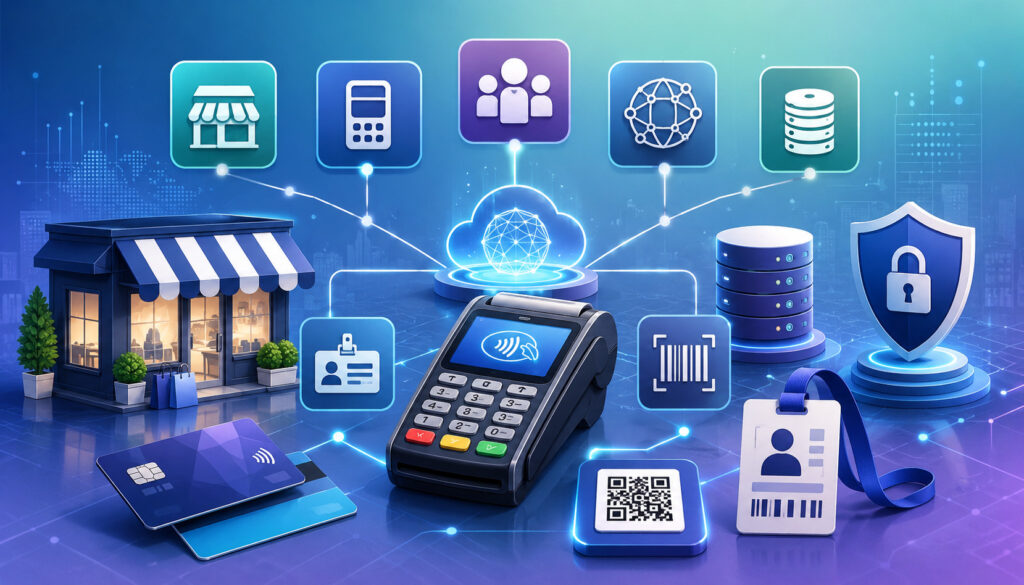
Payment processing contains multiple identifiers because different things need to be identified: the merchant relationship, terminal, transaction, business category, gateway account, authorization, and settlement bank account.
The following comparison provides a useful reference.
| Identifier | What It Identifies | Typical Purpose | Usually Unique To |
| Merchant ID (MID) | Merchant or merchant-processing relationship/account | Account identification, processing records, reporting, support | A merchant-processing relationship within the relevant provider’s system |
| Terminal ID (TID) | Terminal, device, or processing endpoint | Terminal identification and configuration | A specific terminal or endpoint |
| Merchant Category Code (MCC) | Type of merchant business activity | Business classification within card-payment systems | A business category, not an individual merchant |
| Transaction ID | Individual payment transaction | Transaction tracking and investigation | A particular transaction |
| Authorization Code | Authorization response associated with a transaction | Referencing an approved authorization | A particular authorization event |
| Gateway ID | Gateway account, profile, or configuration | Gateway access, configuration, and transaction processing | A gateway relationship or profile |
| Bank Account Number | Deposit account at a financial institution | Receiving or sending funds | A bank account |
The exact naming conventions vary by provider, but these concepts are fundamentally different.
Merchant ID vs. Merchant Account Number
“Merchant ID” and “merchant account number” can sometimes refer to the same account-level identifier in a provider’s documentation. In other systems, the provider may maintain both an MID and another internal account number.
That means there is no safe universal rule saying they are always identical or always different.
A merchant account is the underlying processing relationship or account arrangement that enables the business to accept card transactions. The MID is an identifier associated with that relationship.
An analogy is a customer account and the reference number used to find it. The account contains the relationship, configuration, history, and contractual information; the identifier helps systems or people reference it.
If your statement contains both “Merchant ID” and “Account Number,” ask the processor which one should be provided when support requests your merchant account identification.
Merchant ID vs. Terminal ID
A Merchant ID (MID) generally identifies the merchant or processing relationship.
A Terminal ID (TID) generally identifies a specific terminal, device, or processing endpoint.
For example, a restaurant could have a countertop terminal at the front counter, another terminal at the bar, and mobile devices used tableside. Depending on the processor’s architecture, these endpoints might have separate TIDs while remaining connected to one MID.
Another processor might configure the same business differently.
The distinction becomes important during troubleshooting. If one terminal fails while others continue working, support may need the TID to identify the affected endpoint in addition to the MID that identifies the processing account.
For more context on terminals and payment hardware, this guide to choosing a POS system discusses how POS systems connect business operations with payment acceptance.
Merchant ID vs. Merchant Category Code
An MID and an MCC perform completely different functions.
Merchant ID: identifies a merchant or merchant-processing relationship.
Merchant Category Code: classifies the type of business activity associated with the merchant.
An MCC is not a unique merchant number. Many unrelated merchants operating in the same general category can have the same MCC.
Mastercard describes MCCs as codes used to identify the merchant’s business classification and requires acquirers to provide a valid MCC that reasonably describes the merchant’s primary business in applicable transaction data.
The MCC may influence how transactions are categorized and can be relevant to network rules, risk treatment, and pricing structures. But changing an MCC does not simply mean changing the merchant’s MID; they represent different data.
Merchant ID vs. Gateway ID
A payment gateway handles technology used to transmit payment information between a merchant’s checkout environment and payment-processing infrastructure. The gateway may maintain its own account, profile, site, or credential identifiers.
A gateway ID therefore identifies something within the gateway environment.
A Merchant ID identifies the merchant-processing relationship within the relevant acquiring or processing environment.
An eCommerce business might have both.
For example, an online store could use:
- One eCommerce platform account
- One gateway account
- A gateway profile ID
- A merchant processing MID
- Processor credentials
- One or more settlement accounts
These values may be entered together during integration, which is why confusing an MID with a gateway identifier can cause authentication or configuration problems.
Merchant ID vs. Transaction ID and Authorization Code
A transaction ID identifies an individual payment or processing event. A Merchant ID identifies the merchant-side account or relationship associated with many transactions.
If a retailer processes 500 purchases, the merchant account may remain associated with the same MID while each purchase receives its own transaction reference.
An authorization code is different again. It relates to a particular authorization response and can be useful when researching a transaction, but it does not identify the merchant’s account as a whole.
When processor support investigates a payment, it may request:
- MID
- Transaction ID
- Authorization code
- Date and time
- Transaction amount
- Last four digits of the card where appropriate
- Batch or settlement reference
Each item helps identify a different part of the transaction.
Merchant ID vs. Bank Account and Routing Numbers
A Merchant ID is not a bank account number, and it does not replace the banking information used for merchant settlement.
The merchant processing account identifies the processing relationship. The settlement bank account identifies the bank account where eligible funds are deposited according to the merchant’s processing configuration.
During merchant onboarding, processors commonly request bank account and routing information separately because funds need a designated destination. Merchant account underwriting may therefore involve business banking details in addition to processing-account information.
This distinction is also why changing a settlement bank account does not automatically mean that the Merchant ID must change. The processor may be able to update funding information while leaving the processing relationship intact, subject to verification and account rules.
Is a Merchant ID Unique, and Can a Business Have Multiple MIDs?
Merchant IDs are intended to distinguish merchant-processing relationships within the systems where they are used. However, the scope of that uniqueness depends on the processor, acquirer, platform, and processing architecture.
You should therefore avoid treating an MID like a universally searchable registration number.
A particular MID may be meaningful within one processor or acquiring environment without functioning as a universal public business identifier.
This is another reason merchants should keep clear records showing which processor or acquiring relationship belongs to each MID.
Can One Business Have Multiple Merchant IDs?
Yes. A business can have multiple Merchant IDs, although having several locations or sales channels does not automatically mean multiple MIDs are required.
Multiple MIDs may arise when a business has:
- Separate merchant accounts
- Several physical locations
- Different legal entities
- Multiple brands or DBAs
- Different payment processors
- Separate retail and eCommerce arrangements
- Different risk profiles
- Multiple processing channels
- Account migrations
- Specialized payment programs
- Different currencies or international processing arrangements where supported
- Underwriting requirements that call for separate processing relationships
Consider a business operating a retail store and an online subscription service. Its processor might place both channels under one overall structure, or the channels might receive separate merchant accounts because their transaction patterns and risks differ.
Neither structure is automatically correct for every merchant.
Can Multiple Locations Share One Merchant ID?
They sometimes can, depending on processor configuration, account structure, underwriting requirements, reporting needs, terminal setup, and the way locations are represented to the acquiring environment.
For example, several stores might share an MID while location and terminal identifiers distinguish their transactions. In another arrangement, each location could have a separate MID to provide clearer settlement, reporting, and account management.
Merchants should consider operational consequences when discussing these options with a processor.
Separate identifiers can make it easier to isolate:
- Sales by location
- Chargebacks
- Deposits
- Fees
- Equipment
- Terminal configuration
- Account-level reporting
A shared structure may simplify some administration, but the appropriate choice depends on the provider and merchant operation.
Merchant IDs in eCommerce, POS, Payment Facilitators, and Gateways

Merchant identification is relevant to both physical and online commerce, but merchants may encounter it differently depending on their payment model.
A retailer using countertop terminals may see its MID in terminal-management records or statements. An eCommerce merchant may encounter merchant account identification during gateway configuration. A service business using a virtual terminal may see the identifier in its processing dashboard.
Modern payment platforms can also abstract traditional processor details from the business owner.
Do Online Businesses Have Merchant IDs?
Many individually underwritten eCommerce merchant accounts have an MID or comparable merchant-processing identifier.
Online transactions may involve several separate systems:
- Shopping cart or eCommerce platform
- Checkout page
- Payment gateway
- Processor
- Acquiring institution
- Fraud-management tools
- Recurring billing platform
- Merchant account
- Settlement bank account
An online merchant may therefore have multiple credentials and identifiers even though customers experience a single checkout.
Recurring billing can add another layer because the business may maintain stored payment tokens, subscription IDs, customer IDs, gateway profiles, and transaction identifiers. None of those should automatically be assumed to be the merchant’s MID.
PCI Security Standards Council resources emphasize that payment environments can range from merchant-managed payment pages to arrangements where card-data handling is partially or fully outsourced to third parties. That technical structure affects how merchants interact with payment credentials and account configuration.
Merchant IDs and Payment Facilitators
Payment facilitators can change what the merchant sees.
In a traditional individually underwritten arrangement, the merchant may work directly with a merchant service provider, processor, and acquiring relationship and receive a distinct merchant processing account identifier.
Under a payment-facilitator or aggregated arrangement, smaller sellers may be onboarded beneath a larger processing relationship. The platform may give them an account, submerchant identifier, seller ID, location ID, or other internal reference while keeping portions of traditional processing infrastructure behind the platform.
As a result, asking “What is my MID number?” may not always produce a conventional standalone Merchant ID.
The appropriate question is often:
“Which identifier should I provide when I need processor-level merchant account support?”
That phrasing avoids assuming how the provider has structured your account.
Merchant ID and POS Systems
A POS system and a merchant account are related but distinct.
The POS manages the sales workflow and may handle inventory, receipts, employees, menus, customer records, and reporting. Its payment component connects transactions to payment-processing infrastructure.
Within that environment, you may encounter:
- MID
- TID
- Register number
- Store ID
- Location ID
- Device ID
- Employee ID
- Batch number
One MID may sometimes be associated with several TIDs or registers. That arrangement enables a processor or POS provider to distinguish devices while still associating activity with the correct merchant relationship.
When troubleshooting POS payments, identify exactly which level is failing before replacing or editing credentials.
Merchant ID and Payment Gateways
A gateway sits between a merchant’s online payment experience and downstream payment-processing services. Depending on the integration, the gateway may require processor-specific credentials or merchant account identifiers.
An incorrect MID, gateway account reference, security key, or related configuration value can cause transaction authentication, account-matching, or configuration errors.
But an error message referring to “merchant” credentials does not always mean the MID itself is wrong.
Possible causes include:
- Incorrect merchant identifier
- Inactive processing account
- Wrong gateway profile
- Processor migration
- Test credentials used in production
- Terminal or endpoint mapping errors
- Invalid authentication credentials
- Integration configuration problems
Do not randomly substitute numbers from statements or receipts until transactions begin working. Doing so can make diagnosis more difficult and may introduce additional configuration problems.
Merchant ID, Settlement, Refunds, Chargebacks, and Statements
A Merchant ID becomes particularly useful after the sale, when businesses need to reconcile money and investigate account activity.
Processing does not end when a customer’s card is approved. Transactions still move through capture, clearing, settlement, funding, reporting, and potentially refunds or disputes.
Account identifiers help keep those records associated with the appropriate merchant-processing relationship.
Merchant ID and Payment Settlement
Settlement is the process through which processed transactions move toward final financial accounting and merchant funding according to the applicable payment arrangement.
Businesses often think of settlement in terms of the bank deposit they receive, but processors maintain considerably more information behind that deposit.
Records can include:
- Transactions included in a batch
- Gross processed amount
- Refunds
- Adjustments
- Chargebacks
- Fees
- Settlement totals
- Funding dates
- Merchant account references
The MID can help associate this information with the correct processing account.
If a merchant operates several locations, accurate merchant account identification becomes particularly important during reconciliation. A deposit that appears “missing” may actually have been posted under another account, included in another settlement, adjusted, delayed, or combined depending on the processing structure.
The MID is a useful starting point, but funding depends on the full merchant account configuration, not simply the number printed beside “Merchant ID.”
Merchant ID and Refunds
Refunds are linked to the merchant processing environment and, typically, the original transaction being refunded.
The Merchant ID can help establish which merchant account handled the sale, but the MID alone is not sufficient to issue a refund.
A refund workflow may also depend on:
- The original transaction
- Transaction reference
- Payment credentials or token
- Processor authorization
- User permissions
- Refund amount
- Applicable refund rules
- Whether the original account remains active
If a company recently switched processors, old transactions may require special handling because the original payment belongs to a previous processing relationship.
Keep prior account documentation until your organization no longer needs it for reconciliation, disputes, tax or accounting retention, or other legitimate business requirements.
Merchant ID and Chargebacks
Chargebacks involve individual disputed transactions, not simply a merchant’s overall MID.
However, merchant account information helps processors organize dispute activity and identify which processing relationship is involved.
When reviewing a chargeback, merchants may need to examine:
- Dispute or case number
- Original transaction reference
- Transaction date
- Amount
- Payment method
- Order documentation
- Customer communications
- Shipping or fulfillment evidence
- Refund history
- Merchant account involved
The MID can therefore be useful when communicating with processor support or separating chargebacks from different locations or merchant accounts.
Visa’s merchant-information resources also emphasize the importance of accurate merchant identification information in helping cardholders recognize transactions, which can reduce confusion surrounding card activity and disputes.
Merchant ID and Merchant Statements
Processing statements often provide one of the clearest connections between the MID and actual account activity.
A statement can help a merchant identify:
- Which MID is being billed
- Sales volume
- Transaction counts
- Processing fees
- Refunds
- Chargebacks
- Adjustments
- Funding or settlement information
- Pricing categories
If your company maintains several MIDs, always confirm which account each statement represents before comparing processing costs.
An apparent fee discrepancy can simply result from comparing two different merchant accounts with different transaction mixes or pricing arrangements. For additional context, see this educational overview of credit card processing fees.
Does a Merchant ID Affect Processing Fees or Funding?
The MID itself does not function as a universal pricing code. Two merchant accounts do not automatically receive different processing rates simply because their Merchant ID numbers are different.
What matters is the processing relationship and configuration associated with the account.
Factors that may affect processing costs include:
- Pricing model
- Contract terms
- Transaction type
- Card type
- Card-present versus card-not-present activity
- Merchant category
- Processing volume
- Risk profile
- Chargeback history
- Processor or provider fees
- Gateway fees
- Value-added services
- Network and interchange-related costs where applicable
The Merchant Category Code is particularly worth distinguishing here. Mastercard documentation treats the MCC as the code describing the merchant’s primary business activity. That classification serves a different purpose from the MID.
A merchant’s overall processing configuration may therefore include both an MID that identifies the account and an MCC that categorizes the merchant’s business.
The same principle applies to funding.
The MID does not independently decide when a business gets paid. Funding is governed by the processing account’s settlement configuration, banking information, risk controls, transaction activity, holidays, exceptions, reserves where applicable, and other provider-specific factors.
If funding suddenly changes, investigate the account rather than assuming the MID itself is responsible.
Potential causes could include:
- Settlement cutoffs
- Weekends or banking schedules
- Account reviews
- Reserve arrangements
- Unusual transaction activity
- Bank account changes
- Batch issues
- Chargebacks or adjustments
- Processor migration
- Funding configuration changes
A merchant should provide the MID when contacting support because it helps locate the relevant account, not because the number itself determines the funding schedule.
Can a Merchant ID Change or Expire?
A Merchant ID can change when the underlying processing relationship changes, but not every account update requires a new MID.
Because providers structure accounts differently, merchants should confirm expected identifier changes before modifying integrations, terminals, accounting mappings, or reconciliation procedures.
Situations that may result in a new Merchant ID include:
- Changing payment processors
- Establishing a new merchant account
- Moving to a different acquiring relationship
- Opening a separately configured location
- Creating a separate processing channel
- Changing legal entities
- Major account restructuring
- Processor or platform migration
- Certain underwriting or risk-management changes
Other updates may leave the existing MID intact.
For example, updating contact information, replacing a POS terminal, changing an employee, or modifying certain account settings does not inherently mean a new merchant-processing relationship must be created.
What Happens to Your MID When You Change Processors?
Changing processors commonly involves new merchant-account credentials and identifiers because the business is moving to another processing relationship.
However, the exact result depends on the old and new providers, acquiring configuration, migration arrangement, and underlying account architecture.
Before switching, document your current:
- MID
- Terminal IDs
- Gateway configuration
- Recurring billing setup
- Settlement account
- Reporting structure
- Chargeback responsibilities
- Refund process
- Stored-token or credential arrangements
A processor transition can affect payment technology well beyond the Merchant ID. This guide to switching merchant service providers discusses operational areas businesses should consider during a transition.
Do not delete old processing records immediately after the migration. Historical transactions, refunds, chargebacks, tax records, or reconciliation questions may still refer to the previous MID.
Does a Merchant ID Expire?
A Merchant ID is generally associated with the processing arrangement for which it was established rather than functioning like a credit card with a printed expiration date.
An MID can nevertheless become inactive or obsolete.
That may occur because:
- The merchant account closes
- The business changes processors
- The processing relationship is terminated
- Accounts are consolidated
- The processor migrates accounts
- The acquiring arrangement changes
- A replacement merchant account is opened
An inactive MID may still remain important for historical records.
Should You Keep Your Merchant ID Private?
A Merchant ID should be treated as business account information, but it is important to put the risk in perspective.
An MID is not equivalent to a password, card number, PIN, private cryptographic key, or online-banking credential. Knowing a Merchant ID by itself generally does not give someone direct access to the merchant’s settlement bank account.
That does not mean businesses should publish it unnecessarily.
Account identifiers can provide context that scammers may try to combine with other information during phishing or social-engineering attempts. A caller who already knows your business name, processor, MID, and location can sound more convincing when pretending to represent merchant support.
Reasonable safeguards include:
- Keep account documentation accessible only to employees who need it.
- Avoid posting complete merchant-account identifiers publicly.
- Verify unexpected processor-support calls independently.
- Use official processor contact information.
- Protect gateway and merchant-portal passwords.
- Enable multi-factor authentication when supported.
- Restrict administrative permissions.
- Keep payment software and devices maintained.
- Train staff to recognize credential-reset and phishing attempts.
PCI Security Standards Council merchant resources emphasize strong passwords, controlled remote access, patching, and other basic security practices for protecting payment environments.
Can Someone Steal Money With a Merchant ID?
Possessing an MID alone generally does not provide the credentials required to withdraw money from the merchant’s bank account.
The bigger concern is combining information and impersonation.
For example, a fraudster might collect public information about a business and then obtain merchant account details from discarded paperwork, compromised email, or a deceptive phone call. That information could make a later phishing attempt more convincing.
Businesses should therefore protect the MID alongside other nonpublic account information without treating it as though it were itself a banking password.
If someone unexpectedly asks for your MID:
- Determine why they need it.
- Verify that the person represents an authorized service provider.
- Contact the provider independently if anything seems unusual.
- Never provide passwords, one-time authentication codes, cardholder data, or bank credentials merely because a caller already knows your MID.
What to Do If You Cannot Find Your Merchant ID or It Is Not Working
Merchants frequently discover they need their MID only when a support representative asks for it. If you cannot locate the number immediately, work from the most authoritative account sources rather than guessing.
Use this sequence:
- Check your recent processing statement: Look for Merchant ID, MID, Merchant Number, Merchant Account Number, or similar wording.
- Review your merchant agreement: Account-opening documents may identify the processing relationship.
- Check the processor dashboard: Review account, business, location, settlement, or profile pages.
- Review onboarding communications: Welcome emails and activation documents may contain the account reference.
- Check gateway or POS configuration: Look carefully for merchant-processing information, but distinguish it from TIDs and gateway-specific identifiers.
- Review settlement reports: Account identifiers may appear on deposit or batch reports.
- Contact authorized support: Be prepared to verify your identity or authority over the business account.
Do not send sensitive account documentation to an unverified email address simply because someone claims to be processor support.
What If Your Merchant ID Is Not Working?
First determine what “not working” means.
An MID entered into a gateway may produce an error because the identifier is incorrect, but other explanations are possible.
Common possibilities include:
- Typographical error
- Wrong MID for the location
- Old MID used after a processor migration
- Inactive merchant account
- Gateway account mismatch
- Incorrect processor configuration
- Terminal mapped to the wrong account
- Test-versus-production environment mismatch
- Authentication credential problem
- Incomplete processor provisioning
- Integration error
Do not repeatedly try random merchant numbers from old statements.
If the identifier came directly from your processor and still fails, provide support with the exact error message, system being configured, MID you were instructed to use, relevant TID or gateway reference, and whether the problem affects all transactions or only one channel.
How to Organize Multiple Merchant IDs
Once a company has several locations, processors, or payment channels, merchant identification can quickly become difficult to manage.
Create a restricted internal merchant-account register containing fields such as:
| Internal Record | Example of What to Record |
| Business/DBA | Brand associated with the account |
| Location | Store, website, or department |
| MID | Exact processor-issued merchant identifier |
| Processor | Processing relationship |
| Acquirer | If relevant and known |
| TIDs | Terminals associated with the MID |
| Gateway | Gateway/provider profile reference |
| Settlement account | Internal nickname, not necessarily full account number |
| Status | Active, migrating, or inactive |
| Start date | Account activation date |
| Notes | Special reporting or processing configuration |
Limit access to employees who actually administer payments, accounting, reconciliation, or processor relationships.
Common Merchant ID Mistakes and Questions to Ask Your Processor
Most MID problems do not result from complicated payment-network issues. They happen because several identifiers look similar or because businesses keep outdated account records.
One of the most common mistakes is confusing a Terminal ID with a Merchant ID. A TID normally refers to a terminal or endpoint, while the MID is associated with the merchant-processing relationship.
Another common mistake is confusing the MID with the MCC. Remember that an MCC is a business classification rather than a unique merchant account identifier. Mastercard’s published merchant guidance specifically describes MCC selection in terms of the merchant’s primary business activity.
Other mistakes include:
- Entering a transaction ID when support requests the MID
- Providing a bank account number instead
- Using an old MID after changing processors
- Assuming a gateway profile ID is the MID
- Assuming every provider calls it “Merchant ID”
- Assuming every MID has the same length
- Assuming every number on a receipt identifies the merchant account
- Publishing processing-account details unnecessarily
- Failing to document which MID belongs to which location
- Deleting old account information immediately after migration
- Changing gateway or terminal identifiers without processor guidance
If anything remains unclear, ask your provider directly.
Useful questions include:
- What is my Merchant ID?
- Is this the same as my merchant account number in your system?
- Where is my MID displayed on my statement?
- Do I have more than one Merchant ID?
- Which MID belongs to each location?
- Which Terminal IDs belong to each MID?
- Which identifier should I use for support requests?
- Will adding another location create another MID?
- Will changing gateways affect my MID?
- What happens to my MID if I change processors?
- Which account identifier should my gateway use?
- How should inactive MIDs be handled?
- Who within my organization should have access to this information?
Processor terminology should win over assumptions. If documentation contains “Merchant Number,” “Account ID,” and “MID,” ask the provider to identify exactly what each field represents.
Frequently Asked Questions
What is a Merchant ID?
A Merchant ID, usually abbreviated MID, is an identifier associated with a merchant’s payment-processing relationship or merchant account.
Processors, acquiring institutions, gateways, and related payment systems may use merchant identifiers to associate transaction activity, settlement records, reporting, configuration, and support information with the appropriate merchant relationship.
An MID is not a bank account number, Terminal ID, Merchant Category Code, transaction ID, or authorization code. The exact format and terminology vary by provider.
Some providers call it a Merchant Number or merchant account number, while modern payment-facilitator platforms may expose different seller or account identifiers instead of a traditional standalone MID.
What Does MID Mean in Payment Processing?
MID usually means Merchant ID or Merchant Identification Number in payment processing.
It functions as an account-level identifier associated with a merchant or merchant-processing relationship. The identifier can help processors distinguish the merchant’s transactions and account records from those belonging to other businesses or accounts.
The MID should not be viewed as a complete payment-routing instruction. Card transactions depend on multiple parties, data elements, network connections, account settings, authentication information, and transaction-specific identifiers. The Merchant ID is one identifying component within that larger processing system.
What Is a Merchant Identification Number?
A merchant identification number is another common name for a Merchant ID or MID. It identifies a merchant-processing relationship within a processor, acquiring, or related payment environment.
Depending on the provider, a merchant identification number may appear on statements, merchant agreements, onboarding documents, settlement reports, dashboards, or support records.
Providers do not necessarily follow the same numbering convention, so there is no universal MID length or format that merchants should rely on. When you need the official merchant identifier for your account, check your provider’s documentation or contact authorized support.
Is a Merchant ID the Same as a Merchant Account Number?
Sometimes, but not universally.
A provider may use “Merchant ID,” “Merchant Number,” and “Merchant Account Number” interchangeably for the same account identifier. Another provider may maintain separate numbers for different internal purposes.
Conceptually, the merchant account or processing relationship is the account arrangement through which payment activity is managed. The Merchant ID is an identifier associated with that relationship.
If your statement displays both an MID and a merchant account number, verify the distinction with your provider before entering either into a POS terminal, gateway, or support request.
Is a Merchant ID the Same as a Terminal ID?
No. They generally identify different levels of the payment environment. A Merchant ID identifies a merchant or processing relationship. A Terminal ID (TID) usually identifies an individual POS terminal, device, or processing endpoint.
A business may therefore have one MID associated with several TIDs. For example, a restaurant might have one processing account but separate identifiers for terminals at the bar, counter, and dining area.
Exact configurations vary, so merchants should verify the relationship between their MIDs and TIDs with their processor or POS provider.
Is a Merchant ID the Same as an MCC?
No.
A Merchant ID identifies a merchant-processing account or relationship. A Merchant Category Code (MCC) categorizes the type of business the merchant operates.
Many businesses can share the same MCC because they perform similar business activities. Mastercard’s merchant documentation describes the MCC as a code representing the merchant’s primary business.
An MID, by contrast, is used to distinguish a particular merchant-processing relationship within the relevant payment environment. Confusing the two can lead to incorrect assumptions about processing configuration and fees.
How Many Digits Is a Merchant ID?
There is no universal number of digits that applies to every Merchant ID.
MID formats vary among acquiring institutions, processors, payment platforms, gateways, and account structures. An identifier may be numeric in one environment while another provider may use a different convention.
Do not use character length as the only way to determine whether a number is your MID.
If several identifiers appear on a statement or dashboard, rely on the field label and provider documentation. When necessary, ask support to confirm the exact Merchant ID associated with your merchant account.
Can a Business Have Multiple Merchant IDs?
Yes.
A business may have several MIDs because it operates multiple locations, uses different processors, maintains separate merchant accounts, processes through different legal entities, operates multiple brands, or separates payment channels.
Different currencies, risk arrangements, acquisitions, or account migrations can also result in additional processing identifiers in some environments.
However, businesses with multiple locations do not automatically need multiple MIDs. Several locations or terminals can sometimes operate under a shared processing structure. The appropriate setup depends on the processor, underwriting, reporting requirements, and merchant configuration.
Do Online Businesses Have Merchant IDs?
Many eCommerce businesses with merchant-processing accounts have an MID or comparable processing identifier.
An online merchant may also have a gateway ID, gateway profile, eCommerce platform account, recurring billing identifier, API credentials, and various transaction references. Those values are not necessarily the MID.
Businesses operating through payment facilitators or aggregated platforms may experience merchant identification differently. The platform might expose a seller, submerchant, location, or account identifier instead of presenting a conventional standalone MID.
When uncertain, ask the provider which account identifier represents your processing relationship.
Does My Merchant ID Change When I Switch Processors?
It often can because changing processors may establish a new merchant-processing relationship with new account credentials and identifiers.
However, this should not be treated as an absolute rule. Account migrations, processor partnerships, acquiring arrangements, and platform structures vary.
Before switching providers, document the old MID and any associated TIDs, gateway configuration, reporting details, recurring billing setup, and settlement information.
Keep old account records after the transition because refunds, chargebacks, historical statements, and reconciliation questions may continue referring to transactions processed under the previous MID.
Can I Find My Merchant ID on a Receipt?
Possibly, but you should not assume that a number appearing on a credit card receipt is your complete Merchant ID.
Receipts can contain terminal IDs, store numbers, transaction references, authorization codes, batch information, or truncated merchant-related identifiers. Receipt formats depend on the processor and POS setup.
If you specifically need your MID, a merchant processing statement, merchant agreement, processor dashboard, or authorized support representative is usually a more reliable source. This is particularly important when a receipt contains several account-like numbers.
Should I Keep My Merchant ID Private?
Treat it as nonpublic business account information and avoid sharing it unnecessarily.
An MID is not the same kind of secret as a password, PIN, private authentication key, or card number, and knowing an MID by itself generally does not provide direct access to merchant funds.
However, account identifiers can be useful in social-engineering attempts when combined with other information.
Keep processor documents appropriately restricted, verify unexpected support requests, use strong merchant-portal passwords, and enable multi-factor authentication where available.
PCI Security Standards Council merchant resources provide additional payment-security guidance for businesses.
Can Someone Access My Bank Account With My Merchant ID?
A Merchant ID by itself generally does not provide the credentials necessary to log in to or withdraw funds from your settlement bank account. The MID and bank account number are different identifiers used for different purposes.
Still, avoid exposing merchant account information unnecessarily. Criminals can combine seemingly harmless business details with phishing, impersonation, or compromised credentials.
If someone unexpectedly contacts you asking for your MID and additional sensitive information, independently verify the organization before responding.
Never provide merchant-portal passwords, one-time authentication codes, full payment-card information, or online-banking credentials simply because a caller already knows something about your processing account.
Conclusion
A Merchant ID, or MID, is an identifier associated with a merchant’s payment-processing relationship or merchant account. It helps processors, acquiring institutions, gateways, and related systems associate payments, settlement records, reporting, configuration, and support activity with the appropriate merchant.
The exact format is not universal. One processor may call it a Merchant ID, another may use Merchant Number or merchant account number, and a payment-facilitator platform may expose merchants to a different account structure entirely. Never assume an MID must contain a specific number of digits or follow another provider’s format.
Merchants can commonly find their MID on processing statements, merchant agreements, onboarding records, dashboards, settlement reports, or payment-system settings. When several similar numbers appear, processor confirmation is safer than guessing.
Most importantly, understand what an MID is not. A Terminal ID generally identifies a terminal or endpoint. An MCC classifies business activity. A transaction ID identifies a particular transaction. An authorization code relates to a specific authorization event.
A gateway ID belongs to the gateway environment. A bank account and routing number identify the banking relationship used for funding.
One business can also have several Merchant IDs when it operates multiple accounts, locations, entities, brands, processors, or processing arrangements. Conversely, multiple locations may sometimes share a processing structure, depending on how the provider configures the account.
Merchant IDs can change when businesses establish new processing relationships or undergo certain migrations and restructurings. Keep old account records when identifiers change because historical transactions, statements, refunds, settlement research, and chargebacks may continue referring to the prior account.
Finally, store Merchant IDs responsibly. They are not equivalent to passwords or bank credentials, but they are still business account information that should not be exposed without reason.
Accurate internal records, restricted access, verified support channels, and clear mapping among MIDs, TIDs, gateways, locations, and settlement accounts make payment operations easier to manage when a transaction or deposit needs attention.