
A card transaction can display “approved” within seconds, yet the merchant may not receive the money until much later. That gap is one of the most important concepts for anyone who accepts credit cards or debit cards to understand.
The core difference in payment authorization vs settlement is straightforward: authorization is the stage when the issuing bank evaluates a payment request and approves or declines it, while settlement is the later stage when financial obligations are resolved and funds move through the payment ecosystem toward the merchant.
The Federal Reserve describes card payments as involving authorization, clearing, and settlement between issuing and acquiring institutions through card-network intermediaries.
Several important steps can occur between those two points. A transaction may be authorized, placed on hold, captured by the merchant, included in a payment batch, sent through clearing, settled between financial institutions, and finally deposited into the merchant’s designated bank account.
That is why an approved card transaction does not automatically mean the merchant has been paid.
For merchants, understanding this lifecycle makes it easier to interpret pending transactions, identify missing deposits, manage authorization holds, reconcile batches, distinguish voids from refunds, and understand why a card payment may be approved without appearing in the business bank account.
What Is Payment Authorization?
Payment authorization is the part of credit card processing in which the merchant asks whether a proposed transaction can proceed. When the customer presents a card, enters card information online, or uses a digital wallet, transaction information is transmitted through the merchant’s payment technology toward the cardholder’s issuing bank.
The exact technical route depends on the merchant’s setup. An in-person transaction may begin at a POS terminal, while an ecommerce transaction commonly starts through a payment gateway. The request then moves through a payment processor or acquiring connection and the appropriate card network before reaching the issuing bank.
The issuing bank is the financial institution responsible for the cardholder’s account. It evaluates information related to the transaction and returns an approval or decline response.
The Consumer Financial Protection Bureau explains that authorization tells a merchant whether the account is valid and whether sufficient credit is available for the purchase.
During the payment authorization process, the issuer may evaluate factors such as:
- whether the card or account is active;
- available credit or available funds;
- transaction amount;
- account restrictions;
- card expiration information;
- authentication or security information;
- suspected fraud indicators;
- unusual transaction behavior;
- network and issuer rules.
An approval response generally includes an authorization code or another approval identifier. That approval tells the merchant’s system that the issuer has authorized the transaction at that point in the process.
An authorization may also affect the customer’s available balance or credit. This is commonly called an authorization hold. For example, a $100 authorization could temporarily reduce the amount of credit the cardholder can use even though the transaction has not yet completed settlement.
The critical distinction is that authorization is not a completed transfer of merchant funds. The merchant has received permission to proceed with the approved transaction, not necessarily a final bank deposit.
What Is Payment Settlement?
Payment settlement occurs later in the transaction lifecycle. It relates to fulfilling the financial obligations created by processed card transactions so funds can move between the parties involved in the payment system.
Before settlement normally takes place, the merchant must have a transaction that is eligible to proceed. In many card-processing environments, that means an authorized transaction has been captured and submitted for processing.
Captured transactions may be grouped into a batch. The processor or acquiring side then submits transaction information into the applicable clearing process. During clearing, transaction records are exchanged, validated, reconciled, and used to determine what the different participating institutions owe one another.
Settlement deals with fulfilling those resulting financial obligations.
A simplified sequence looks like this:
- The merchant captures approved transactions.
- Transactions are submitted individually or through a payment batch.
- Clearing information is exchanged through the payment ecosystem.
- Financial obligations between participating institutions are calculated.
- Settlement occurs according to the applicable network and banking arrangements.
- The merchant’s processor, acquirer, payment facilitator, or other provider completes the merchant-funding process.
- The merchant sees a deposit in the designated settlement bank account.
This is why credit card settlement should not always be treated as identical to the moment a merchant sees a deposit. Network or acquiring-side settlement and the merchant’s final funding event are closely connected, but they can occur at different operational points.
Funding can also reflect deductions or adjustments. Depending on the merchant’s agreement, the deposited amount may be affected by processing fees, refunds, chargebacks, reserves, prior adjustments, funding holds, or other account activity.
Merchants reviewing their cash flow should therefore look at both settlement information and funding reports rather than assuming that the sales total for a particular day must exactly match a single bank deposit.
Payment Authorization vs Settlement: Key Differences
The difference between authorization and settlement mainly comes down to purpose and timing. Authorization determines whether a proposed transaction may move forward. Settlement occurs later and addresses the actual financial obligations created after qualifying transactions have been captured and cleared.
This distinction applies whether someone is comparing credit card authorization vs settlement, card authorization vs settlement, or the broader payment-processing lifecycle.
| Feature | Authorization | Settlement |
| Main purpose | Obtain issuer approval for a transaction | Fulfill financial obligations arising from processed transactions |
| When it occurs | Near the beginning of the transaction | Later, after capture and clearing in typical card flows |
| Main parties involved | Merchant, gateway/processor/acquirer, card network, issuing bank | Processor/acquirer, card network, issuing bank, settlement institutions |
| Funds or credit checked | Usually yes | The authorization decision has already occurred |
| Funds actually transferred | Not necessarily | Financial movement between participating institutions occurs |
| Merchant has money yet? | Usually no | Merchant funding generally follows or is closely connected |
| Transaction can still change? | Often yes | Fewer changes are possible once processing progresses |
| Common issues | Declines, duplicate attempts, expired authorizations, holds | Batch problems, funding delays, account holds, bank issues |
An authorization is therefore closer to permission and reservation than payment completion. When an issuer approves a transaction, it is effectively saying that the transaction meets the issuer’s conditions for approval at that moment.
Settlement is further downstream.
Even after authorization, several things can change. A restaurant may add an approved tip. A hotel may adjust an estimated amount. An ecommerce merchant may cancel an order before capture. An authorized transaction might expire if it is not captured under applicable processing rules.
Settlement is also distinct from merchant funding. Settlement helps resolve the payment obligations within the card ecosystem, while funding describes the merchant actually receiving the resulting deposit through its acquiring or payment-provider relationship.
Understanding these distinctions helps prevent one of the most common accounting mistakes in credit card processing: treating approved transactions as deposited cash.
Step-by-Step Card Payment Flow From Authorization to Merchant Funding
Although card processing involves sophisticated infrastructure, merchants can understand the transaction lifecycle as a sequence of recognizable stages. Details vary among card networks, processors, transaction types, debit-routing methods, and merchant configurations, but the following framework explains the typical flow.
1. Customer Initiates the Payment
The transaction begins when a customer presents a payment credential. This might involve inserting an EMV chip card, tapping a contactless card or mobile wallet, entering card information at an ecommerce checkout, using a stored credential, or giving payment information through another supported channel.
The merchant’s POS system, payment gateway, or application collects the necessary transaction data and sends it into the processing environment. For ecommerce merchants, this is one reason payment gateways are an important part of the payment stack.
Card-not-present environments also require appropriate controls for protecting payment data; the PCI Security Standards Council provides merchant guidance for both card-present and card-not-present environments.
The transaction has not been settled at this point. The merchant is only beginning the authorization process.
2. Authorization Request Is Sent and Evaluated
The merchant’s processor or acquiring connection routes the transaction through the appropriate card network. The network identifies or communicates with the issuing side so the authorization request can be evaluated.
The issuing bank considers the transaction and responds with an approval, decline, or another permitted response. A successful transaction authorization often produces an authorization code and may create an authorization hold against available credit or funds.
The merchant’s terminal or checkout typically receives the response within seconds, which creates the appearance that the whole payment has finished instantly. Financial settlement has not necessarily happened, however.
An authorization establishes that the transaction may proceed based on the issuer’s decision at that point. It does not establish that merchant settlement or merchant funding has already occurred.
3. Merchant Captures the Payment
Payment capture is the merchant-side step that confirms an authorized transaction should continue toward clearing and settlement. Depending on the merchant’s system, capture can occur automatically shortly after authorization or can be delayed.
A typical retail sale may use automatic capture. Other businesses may deliberately separate authorization from capture. Ecommerce merchants, for example, might authorize an order when it is placed but capture the transaction when goods ship.
This difference is operationally important. An authorized transaction that remains uncaptured may never proceed through normal settlement.
Payment platforms can use terms such as “captured,” “submitted,” “completed,” or “ready for settlement.” Merchants should understand the terminology used by their own processor rather than assuming every dashboard uses identical status labels.
4. Batching, Clearing, Settlement, and Funding Follow
Captured transactions may be grouped through payment batching. A merchant’s POS system might automatically close a batch at a scheduled time, or staff might manually initiate batch settlement.
The transactions then proceed into clearing and settlement. Clearing involves exchanging and reconciling transaction information and determining payment obligations. Settlement fulfills those obligations through the financial infrastructure supporting the card network.
Finally, the merchant is funded according to its acquiring or payment-provider arrangement. The bank deposit may contain multiple transactions rather than one deposit per sale.
This is why reconciling a merchant bank account requires more than matching individual authorization amounts. The merchant may need to compare sales reports, batch totals, settlement reports, adjustments, fees, and deposit references.
A useful companion resource is this guide to reading a merchant processing statement, which explains how transaction and deposit information may appear in merchant reporting.
Authorization vs Capture vs Clearing vs Settlement vs Funding

These five terms describe related but separate functions. Treating them as interchangeable creates confusion when a transaction becomes delayed, canceled, adjusted, or disputed.
Authorization asks whether the issuer approves the payment request.
Capture tells the processing system that the merchant wants an authorized transaction submitted for completion.
Clearing exchanges transaction information and calculates obligations among the relevant participants.
Settlement fulfills those financial obligations.
Funding is the merchant-facing deposit event in which proceeds reach the merchant’s designated bank account according to the provider’s funding arrangement.
A concise comparison is:
- Authorization = approval
- Capture = merchant confirms the transaction should proceed
- Clearing = transaction information and obligations are reconciled
- Settlement = financial obligations are fulfilled
- Funding = merchant receives the resulting deposit
Authorization vs Capture
Authorization and capture may happen close together, which is why merchants sometimes assume they are the same event. They are not.
Suppose an online merchant receives a $250 order. The merchant may authorize the customer’s card immediately to determine whether the payment can be approved. If inventory still needs to be verified, the merchant may wait to capture the transaction until the order is ready for fulfillment.
If the order is canceled before capture, the merchant may be able to void or reverse the authorization rather than complete the sale and issue a later refund.
Delayed capture is particularly useful when the final transaction amount or fulfillment status is not known at the moment of authorization. However, merchants must follow applicable processor and card-network rules because authorizations do not remain valid indefinitely.
Capture vs Settlement
Transaction capture advances a payment toward settlement, but it does not mean settlement itself has already happened.
Capture is essentially the merchant’s instruction to proceed with the approved transaction. After capture, the transaction may still need to be included in a batch, submitted for clearing, processed by network and banking systems, and incorporated into merchant funding.
A captured payment can therefore appear as successful in merchant software while the related bank deposit has not yet posted.
This distinction is especially useful when troubleshooting an approved transaction. If authorization succeeded but capture did not, the problem is near the merchant or payment-platform stage.
If capture succeeded and the batch settled but funding is missing, the investigation should move toward settlement reports, funding schedules, holds, reserves, and bank posting.
Clearing vs Settlement
Clearing and settlement are closely connected but have different jobs. Clearing concerns transaction information, reconciliation, and calculation of obligations. Settlement concerns satisfying those obligations financially.
For example, the clearing process helps identify which transactions belong to participating issuers and acquirers and what amounts are owed after applicable adjustments. Settlement then moves value through the relevant settlement mechanisms.
Mastercard’s current transaction-processing materials likewise distinguish authorization and clearing requirements, including card-processing environments that use separate authorization and clearing messages.
For most small merchants, the key operational lesson is not the underlying network accounting. It is knowing that a captured transaction still has additional processing stages before the merchant can treat the money as available in its bank account.
Authorization Holds, Pending Transactions, and Expiring Authorizations

An authorization hold is a temporary reservation that can reduce the cardholder’s available credit or available account balance while a transaction is pending. The hold helps support a transaction that has been approved but has not completed the full payment lifecycle.
Authorization holds are especially visible in industries where the exact final amount is uncertain when the customer first presents the card.
Common examples include:
- hotels;
- car rentals;
- restaurants;
- fuel stations;
- businesses accepting deposits;
- businesses with estimated or variable final charges.
A hotel might authorize an estimated amount that covers room charges and anticipated incidentals. A restaurant may obtain an initial authorization before the final tip-adjusted transaction is captured. A rental business may need an estimated authorization when the exact final amount depends on the rental period or other charges.
Visa’s merchant guidance discusses incremental authorizations and partial reversals in situations where estimated amounts can change, including lodging and rental-related transactions.
Why an Approved Payment Can Still Be Pending
A pending card transaction usually means the transaction has not finished every stage necessary for final posting. It does not automatically mean the payment failed.
The authorization may already be approved while the merchant has not yet captured the transaction. Alternatively, capture may have occurred while the transaction is waiting for batch submission, clearing, settlement, or final posting by the cardholder’s financial institution.
Pending status can also result from transaction-specific workflows. Hotels, restaurants, rental companies, and fuel merchants may begin with estimated authorizations and finalize the amount later.
Merchant and consumer displays may use different status terminology. One system may call a transaction “authorized,” another “pending,” and another “open.” Merchants should rely on processor transaction details and settlement reporting rather than interpreting a single customer-facing status label.
How Long Does Authorization Last?
There is no universal authorization expiration period that applies to every card payment. Validity depends on factors that can include the card network, processor, transaction category, merchant type, transaction circumstances, and applicable operating rules.
If a merchant leaves an authorization uncaptured for too long, it can expire. The issuer may release the associated authorization hold, and the merchant may need another authorization before completing the transaction.
This is why businesses using delayed capture should know the rules and configuration associated with their payment provider.
Hotels, rentals, ecommerce businesses, and other merchants that routinely separate authorization from capture should pay particular attention to their provider’s documentation. Assuming that any authorization remains available indefinitely can lead to declined captures, customer confusion, or reconciliation problems.
Authorization Reversals, Voids, and Refunds
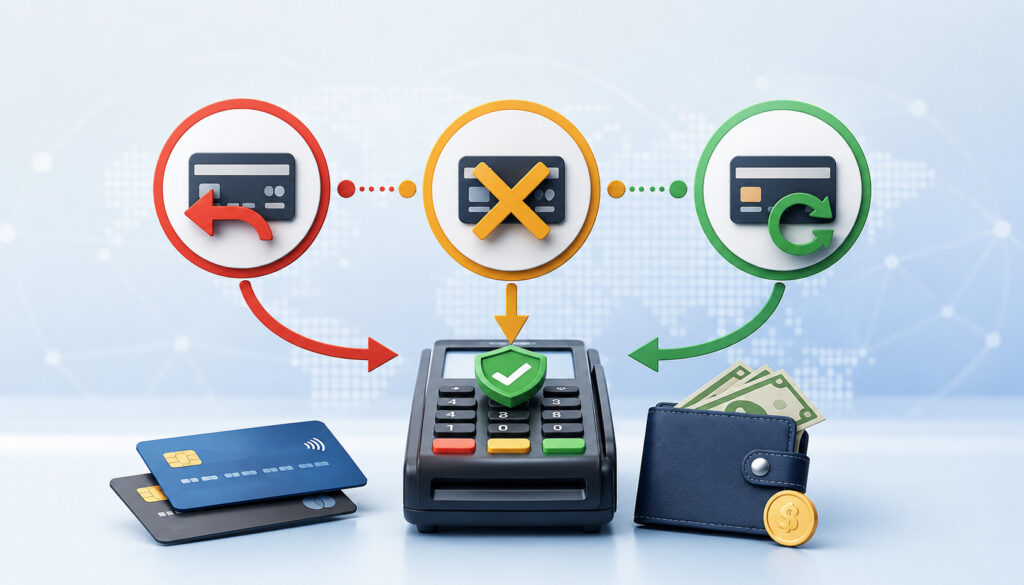
A canceled card transaction does not always require a refund. The appropriate transaction type often depends on how far the payment has progressed.
An authorization reversal, a void transaction, and a refund can all result from a canceled or changed purchase, but they occur at different stages and have different effects.
Authorization Reversal Explained
An authorization reversal tells the payment ecosystem that all or part of a previously authorized amount is no longer needed. This can help release an unnecessary authorization hold rather than leaving the cardholder’s funds or credit tied up until the authorization naturally expires.
A full reversal may be appropriate when a sale is canceled before completion. A partial reversal may be used where supported when the final transaction amount is lower than the amount originally authorized.
Visa specifically explains that authorization reversals are important when transactions are canceled or when an approved amount will not be used. Its guidance notes that not every authorization ultimately settles and that unused authorizations can restrict a cardholder’s available funds.
Businesses should follow the procedures supplied by their processor or gateway because transaction-management options and terminology vary.
Void vs Authorization Reversal vs Refund
A void generally cancels a transaction before it completes settlement or before the processor’s applicable batch-processing point. Depending on the payment platform, voiding an authorized or captured transaction may also trigger the necessary reversal messaging behind the scenes.
An authorization reversal specifically addresses an existing authorization. Its purpose is to notify the issuer or payment system that some or all of that authorization should no longer be held.
A refund occurs after the original transaction has progressed far enough that simply canceling the pending transaction is no longer appropriate. The merchant initiates a new credit transaction that returns money to the cardholder through the payment system.
This leads to an important operational rule: before issuing a refund, verify whether the transaction has actually settled. If it is still an open authorization or unsettled transaction, a void or reversal may be the correct action instead.
A refund can also affect future merchant funding. The amount may be deducted from a later settlement deposit, netted against current processing activity, or handled according to the processor’s funding rules.
Batch Settlement and Settlement Timing
Batch settlement is the process of grouping eligible card transactions and submitting them for downstream processing. Traditional POS environments often use a daily batch, although modern platforms may automate much of this process.
A batch can contain multiple captured sales and sometimes other transaction activity such as refunds or adjustments. Closing the batch tells the processing system that those transactions are ready to advance through clearing and settlement.
Businesses may encounter:
- automatic batching at a scheduled time;
- manual batch closing;
- configurable cutoff times;
- multiple batches in one business day;
- ecommerce systems that submit transactions continuously;
- integrated platforms where batching is largely invisible to staff.
The merchant’s batch schedule can influence the funding date. If a transaction misses a processor’s cutoff, it may fall into a later processing cycle.
Other factors affecting settlement and merchant funding can include:
- the processor’s settlement schedule;
- the time the batch was submitted;
- the acquiring-bank relationship;
- weekends;
- banking holidays;
- merchant risk controls;
- account reviews;
- reserves or funding holds;
- transaction exceptions;
- failed deposits;
- the merchant’s receiving bank;
- bank posting schedules.
For these reasons, merchants should not assume that every transaction settles on the same timetable or that every business receives funds the next day.
Processing charges can also be associated with authorization, batching, settlement, and other stages. Merchants reviewing related costs can consult this overview of credit card processing fees for additional context.
Settlement vs Merchant Funding
Settlement and merchant funding are closely related, but they are not necessarily the same timestamp.
Settlement concerns financial obligations among institutions participating in the payment system. Merchant funding concerns the proceeds that the processor, acquirer, or payment facilitator deposits into the merchant’s designated account.
The funding amount may also differ from the gross sales amount.
For example, a batch might contain $8,000 in sales, but the merchant’s actual deposit could be affected by refunds, fees, chargebacks, reserves, prior adjustments, or another funding arrangement. That does not necessarily mean transactions are missing.
Merchants should reconcile three records: transaction activity, settlement or batch reports, and actual bank deposits. Looking at only one can make normal adjustments appear to be processing failures.
A $100 Authorization vs Settlement Example
Consider a hypothetical $100 retail purchase.
The customer taps a card at the merchant’s payment terminal. The terminal sends the transaction information into the merchant’s processing environment, where it is routed through the relevant payment network toward the issuing bank.
The issuing bank reviews the request and approves $100. The merchant’s POS displays “approved” and receives an authorization identifier.
At that point, the merchant has a valid approval, but the business has not necessarily received $100.
The issuer may place a $100 authorization hold against the cardholder’s available credit. The cardholder could see the transaction listed as pending.
Next, the merchant captures the $100 sale. If the merchant uses batch processing, that captured transaction becomes part of a batch with other sales.
At the merchant’s scheduled batch close, the transactions are submitted for further processing. Clearing information moves through the relevant parties so the payment obligations associated with the transactions can be calculated and reconciled.
Settlement then occurs under the applicable network and banking arrangements.
Afterward, the merchant’s processor, acquirer, payment facilitator, or other provider initiates or completes funding according to the merchant’s account arrangement. The $100 transaction may be part of one combined deposit containing many transactions.
The merchant’s actual bank deposit does not necessarily appear as exactly $100. Depending on the merchant agreement, fees or adjustments may be handled separately or netted from deposits.
This example demonstrates the central difference between payment authorization and settlement. The $100 approval occurs near the beginning; the merchant’s receipt of funds occurs near the end.
Who Is Involved in Payment Authorization and Settlement?
A card payment may appear to involve only a customer and a merchant, but several entities and technologies can participate behind the scenes. Roles also vary depending on whether the merchant uses a traditional merchant account, an independent acquiring arrangement, or a payment-facilitator model.
The basic participants include the following.
Cardholder: The customer or authorized user presenting the payment credential.
Merchant: The business accepting the card payment in exchange for goods or services.
Payment gateway: Technology commonly used to securely transmit transaction information from ecommerce checkouts, virtual terminals, payment links, and other digital payment environments.
Payment processor: A provider or processing system that helps route authorization requests, capture transactions, submit payment data, report activity, and support settlement-related operations.
Acquiring bank: The financial institution on the merchant side of the card-processing relationship. The acquirer connects merchants or merchant providers to the card ecosystem and participates in clearing and settlement.
Card network: The network infrastructure and rules connecting the acquiring and issuing sides of card transactions. Major networks support transaction authorization, clearing, settlement, dispute procedures, and operating standards.
Issuing bank: The institution responsible for the customer’s card account. It evaluates authorization requests and ultimately participates on the cardholder side of clearing and settlement.
Merchant account or payment-facilitator arrangement: The structure through which the business is authorized to accept card transactions. Traditional merchant accounts and payment-facilitator setups can differ operationally.
Merchant bank account: The business’s designated deposit account where merchant funding is ultimately received.
Businesses researching account structures can also review common merchant account approval requirements to understand why acquiring relationships involve underwriting and business information.
Understanding these roles makes troubleshooting easier. A declined authorization usually points toward the authorization path, while a completed batch with no deposit may require attention to the acquiring, funding, or banking side.
Authorization and Settlement Across Different Payment Environments
The underlying concepts of authorization, capture, clearing, settlement, and funding remain useful across many card-acceptance environments. However, transaction workflows differ depending on where and how the customer pays.
Credit Cards and Debit Cards
Credit-card transactions normally involve issuer authorization before the transaction proceeds. The issuer checks the customer’s credit account and returns an approval or decline. Captured transactions then advance through clearing and settlement.
Debit cards follow many of the same general concepts, but merchants should not assume every debit transaction uses an identical route. Debit processing can vary based on factors such as PIN use, network selection, merchant configuration, transaction type, and applicable routing requirements.
With a debit authorization, the customer’s available bank balance can be affected quickly by an authorization hold. With a credit card, an authorization generally reduces available credit.
In either case, the presence of an authorization does not mean the merchant’s bank account has already been funded.
Online and Recurring Payments
For ecommerce, the payment gateway plays a particularly visible role. A customer’s card information is submitted through the online checkout, transmitted securely, evaluated through authorization, and returned with an approval or decline response.
Online merchants may capture immediately or delay capture until an order reaches a certain fulfillment stage. Fraud screening, address-related checks, authentication tools, tokenization, stored credentials, and gateway controls may also influence the workflow.
Recurring transactions often rely on stored payment credentials or tokens. Subsequent transactions may be merchant-initiated under applicable card-network rules and the merchant’s agreement with the customer.
Each successful recurring transaction still needs to move through the appropriate processing stages before merchant funding occurs.
In-Person, Restaurant, Hotel, and Rental Payments
In-person payments commonly originate through POS terminals using EMV chips, contactless credentials, or mobile wallets. Authorization usually takes place while the customer is at the checkout.
Restaurants can have additional steps because the initial authorization may occur before the customer adds a tip. The final amount submitted for capture can therefore differ from the initial transaction amount, subject to the merchant’s system and card-network rules.
Hotels and rental businesses commonly work with estimated amounts because the final cost may not be known at check-in or pickup. Incremental authorization procedures may be available where applicable when the estimated amount needs to increase.
When the final amount is lower than an existing authorization, appropriate reversal procedures can help reduce unnecessary holds.
For merchants using chip and contactless acceptance, this guide to the EMV liability shift and card-present transactions provides additional background on transaction security and dispute responsibility.
What Happens When Authorization or Settlement Goes Wrong?
Not every payment completes successfully. Problems can occur during authorization, capture, batching, settlement, or funding, and knowing the stage of failure is often the fastest way to diagnose the issue.
When an authorization is declined, the transaction normally does not proceed through the usual capture and settlement flow as an approved sale.
Common reasons for authorization declines can include:
- insufficient available credit or funds;
- expired or invalid card details;
- issuer fraud controls;
- account restrictions;
- incorrect payment information;
- security verification failures;
- technical or connectivity problems;
- duplicate transaction attempts;
- transaction limits.
The merchant does not necessarily receive the exact underlying reason for every decline. A terminal or gateway may return only a general response code or instruction.
If authorization succeeds but the transaction is never captured, the authorization may eventually expire. The associated hold may then be released according to issuer and network handling, and the merchant could need a new authorization before charging the customer.
A different situation occurs when authorization and capture succeed but settlement or merchant funding is delayed.
Possible causes include:
- batch submission failure;
- batch not being closed;
- incorrect settlement account details;
- acquiring-account review;
- processor funding hold;
- reserve requirements;
- risk investigation;
- bank account rejection;
- bank posting delay;
- holiday processing schedules;
- technical settlement issues;
- refunds or chargebacks offsetting expected funding.
A merchant should therefore identify the last successfully completed transaction stage before trying to determine what went wrong.
Refunds, Chargebacks, and Their Effect on Settlement
Settlement is not always the end of the financial relationship between a merchant and a card transaction. Refunds and chargebacks can create later adjustments that affect the merchant’s account or funding.
A refund is initiated by the merchant. The business decides to return all or part of the customer’s money after the original transaction has progressed past the point where a void would normally be appropriate.
The refund travels through the payment-processing system as a separate transaction. The merchant’s processor may deduct the refund from upcoming settlement activity, debit the merchant’s account, or apply another funding treatment allowed under the merchant agreement.
The customer’s refund posting time can differ from the time the merchant initiated it because issuer processing and bank posting still have to occur.
A chargeback is different. It arises through the card dispute process rather than being a voluntary merchant refund. A cardholder may dispute a transaction with the issuer for reasons permitted by card-network rules, such as fraud claims, merchandise or service issues, processing errors, or other recognized dispute categories.
A dispute can lead to a debit or adjustment against merchant funding. Depending on the dispute process and merchant arrangement, funds may be removed provisionally while the case is reviewed.
The merchant may be able to respond with evidence if the applicable rules provide a response opportunity. The ultimate financial result depends on the dispute circumstances, submitted evidence, network rules, and account agreement.
Chargebacks demonstrate why a successfully settled transaction should not always be viewed as permanently immune from later adjustments. Card-network dispute procedures can operate after initial authorization and settlement.
How Merchants Can Troubleshoot Missing Payments
When an expected deposit does not arrive, searching only for an authorization approval can lead merchants in the wrong direction. The most effective approach is to follow the transaction in order from authorization through merchant funding.
Use this checklist:
- Verify authorization status: Confirm whether the issuer actually approved the transaction and record its transaction ID and authorization code.
- Confirm capture status: Make sure the authorized payment was captured rather than left open, canceled, or allowed to expire.
- Check the batch: Determine whether the transaction was included in the correct batch and whether that batch successfully closed.
- Review settlement reports: Look for the transaction in the processor’s settlement or reconciliation reporting.
- Confirm the expected funding date: Compare the batch-close time with the processor’s cutoff and funding schedule.
- Check for reserves or funding holds: Account reviews, risk actions, reserves, and other restrictions can affect available merchant funding.
- Verify bank details: Confirm that the designated settlement account is active and that routing and account information remain correct.
- Review processor notices: Look for alerts involving returned deposits, account reviews, documentation requests, system issues, or settlement changes.
- Contact authorized processor support when needed: Provide the transaction ID, batch ID, expected settlement date, and any available deposit reference.
The goal is to identify the exact stage at which the expected transaction stopped progressing.
A merchant processing statement can also reveal settlement totals, deductions, fees, adjustments, and other activity. Businesses should reconcile these reports regularly instead of waiting until a deposit appears missing.
How Authorization and Settlement Appear on Merchant Reports
Payment reports often contain several statuses or identifiers for the same transaction. Because terminology varies by processor and platform, merchants should learn how their own provider labels each stage.
Common report fields include:
- transaction ID;
- authorization code;
- authorization status;
- payment status;
- capture status;
- transaction date;
- capture date;
- batch ID;
- batch status;
- settlement date;
- gross settlement amount;
- refunds;
- chargeback adjustments;
- fees;
- reserve deductions;
- funding amount;
- funding date;
- deposit reference.
An authorization code indicates that the authorization request was approved, but it should not be interpreted as proof of settlement.
A batch ID helps identify which group of transactions was submitted together. This is particularly useful when the merchant’s bank deposit reflects the net value of an entire batch rather than each sale individually.
The settlement date may identify a processing event rather than the precise moment the merchant’s receiving bank posts the deposit. Similarly, a funding date could represent when the processor initiated a deposit rather than when the merchant’s bank made the funds visible.
Terminology such as “paid,” “completed,” “settled,” and “funded” is not standardized across every merchant dashboard. When reconciling transactions, review the provider’s reporting definitions rather than assuming labels carry identical meanings.
Merchant statements may also contain processing fees related to authorizations, transactions, gateways, batches, disputes, or other services. This makes transaction-level reporting and monthly statement review complementary rather than interchangeable.
Common Myths About Payment Authorization and Settlement
Misunderstandings about authorization and settlement can lead to accounting errors, unnecessary customer refunds, duplicate transactions, and confusion about cash flow.
Myth: Approved means paid
Approval means the issuing bank authorized the transaction. Capture, clearing, settlement, and merchant funding may still need to occur.
Myth: A pending transaction was declined
A pending card transaction may already be authorized. It may simply be waiting for capture, settlement, final amount confirmation, or issuer posting.
Myth: Authorization immediately transfers money to the merchant
Authorization commonly reserves or confirms availability of credit or funds. It is not the merchant’s final deposit.
Myth: Capture and settlement are the same thing
Capture tells the payment system that the merchant wants the transaction processed. Settlement occurs later after additional payment-processing activity.
Myth: Clearing and settlement are interchangeable
Clearing focuses on transaction information, reconciliation, and obligations. Settlement fulfills those obligations financially.
Myth: Settlement and merchant funding always happen simultaneously
They are closely related, but the settlement event within the payment ecosystem and the merchant-facing bank deposit do not necessarily share the same timestamp.
Myth: Every card transaction settles instantly
Settlement and funding depend on processor schedules, batch timing, bank posting, holidays, account arrangements, risk controls, and other factors.
Myth: Every authorization hold lasts the same amount of time
Authorization validity varies by network, transaction type, merchant category, processor, issuer handling, and other circumstances.
Myth: A completed settlement can never change
Refunds, chargebacks, adjustments, reserves, and other account activity can affect merchant funds after the original transaction.
Recognizing these distinctions gives merchants a much more accurate picture of payment status and available cash.
Best Practices for Managing Authorization, Settlement, and Funding
Merchants do not need to become payment-network engineers, but a few operating habits can prevent many common payment problems.
First, understand your batch cutoff time. If your processor uses scheduled batching, transactions submitted after the cutoff may fall into a later processing cycle.
Capture transactions promptly when the business model allows it. If delayed capture is necessary, make sure staff or software understands authorization-validity requirements.
Monitor open and pending transactions. An unusually old authorization may indicate an order that was never captured, an abandoned transaction, or a process that requires attention.
Review settlement reports regularly rather than only checking the bank balance. Settlement reports make it easier to identify batch totals, refunds, adjustments, and funding differences.
Reconcile deposits to processing activity. Remember that bank deposits may be net amounts rather than exact sales totals.
Keep settlement-account information current. A bank-account change that is not properly updated with the processor can create failed deposits or delays.
Follow the processor’s procedures for authorization adjustments, reversals, voids, refunds, and incremental authorizations. These operations are not interchangeable.
Monitor chargebacks and failed deposits. Both can affect merchant funding even after successful sales.
Retain appropriate transaction records according to applicable requirements and your provider’s policies. Good records can help with accounting, customer questions, payment investigations, and disputes.
Finally, protect cardholder data throughout the transaction lifecycle. PCI DSS establishes technical and operational requirements for organizations that accept or process payment transactions, making security relevant whether payments occur online or in person.
Frequently Asked Questions
What is payment authorization?
Payment authorization is the stage in which a merchant sends a transaction request through its processing environment to the cardholder’s issuing bank. The issuer evaluates the transaction and returns an approval, decline, or another supported response.
Approval means the transaction has permission to proceed based on the issuer’s decision at that time. It may also result in an authorization hold that temporarily reduces the cardholder’s available credit or funds. Authorization does not mean merchant settlement or funding has already occurred.
What is payment settlement?
Payment settlement is the later stage in which the financial obligations associated with processed card transactions are fulfilled through the payment ecosystem. Before settlement, an authorized transaction normally needs to be captured and submitted for clearing.
Settlement supports the movement of value between participating financial institutions. Merchant funding is closely connected to settlement but may occur as a separate provider-to-merchant deposit step.
What is the difference between authorization and settlement?
Authorization determines whether an issuer approves a transaction. Settlement occurs later and deals with resolving the financial obligations created by the processed transaction.
Between them, the merchant may capture the payment, submit it in a batch, and have the transaction pass through clearing. The simplest comparison is: authorization approves the payment; settlement resolves the money movement associated with it.
Does authorization mean the merchant has been paid?
No. An approved authorization means the issuer has approved the transaction request, not that money is already in the merchant’s bank account. The transaction generally must still be captured, cleared, and settled.
Merchant funding then delivers the applicable proceeds to the merchant’s designated account. An authorization can therefore appear successful while the related merchant deposit is still pending.
What happens after a credit card transaction is authorized?
After authorization, the merchant typically captures the transaction. Captured transactions can then be submitted individually or through a batch for clearing. Clearing exchanges transaction information and determines financial obligations between participating institutions.
Settlement fulfills those obligations, and merchant funding ultimately results in the business receiving its deposit according to the processor or acquiring arrangement.
What is an authorization hold?
An authorization hold is a temporary reservation associated with an approved transaction. It can reduce the cardholder’s available credit or available balance while the payment is still pending.
Holds are especially common for businesses such as hotels, restaurants, fuel stations, and rental companies where the amount authorized initially may differ from the final charge. The hold is later replaced, adjusted, released, or reversed according to the transaction outcome and applicable rules.
What is payment capture?
Payment capture is the merchant-side action that confirms an authorized transaction should continue toward clearing and settlement. Authorization provides approval; capture tells the processing system to proceed with the charge.
Some systems authorize and capture almost immediately, while others allow delayed capture. Ecommerce businesses, for example, may authorize when an order is placed and capture later when goods are ready to ship.
What is the difference between capture and settlement?
Capture happens before settlement in a typical card-processing flow. The merchant captures an authorized transaction to submit it for completion.
Settlement takes place later after the transaction passes through clearing and participating institutions’ financial obligations are determined. A transaction can therefore be captured successfully while the merchant is still waiting for settlement and funding.
What is the difference between clearing and settlement?
Clearing is the exchange, validation, reconciliation, and calculation process used to determine transaction obligations among payment participants. Settlement fulfills those obligations financially.
The terms are closely related because they are sequential parts of payment processing, but they describe different functions. Clearing determines what needs to be settled; settlement carries out the financial result.
Why is an approved payment still pending?
An approved payment can remain pending because authorization is only an early stage of the transaction. Capture might not have occurred yet, the merchant may not have closed its batch, clearing may still be underway, or the issuer may not have completed final posting.
Estimated transactions such as hotel, restaurant, fuel, or rental payments can also remain pending while the final amount is determined.
How long does settlement take?
There is no universal settlement or funding timeline for every merchant. Timing can depend on the processor, batch cutoff, transaction day, card-processing arrangement, acquiring institution, weekends, banking holidays, merchant risk profile, settlement-account setup, and the receiving bank’s posting schedule.
Merchants should use the funding calendar provided in their actual processing agreement rather than assume that every transaction qualifies for same-day or next-day funding.
What happens if an authorization is never captured?
An uncaptured authorization may eventually expire according to the rules that apply to the transaction. The cardholder’s authorization hold may be released, and the merchant may no longer be able to settle the original authorization.
If the merchant still needs to collect payment, reauthorization may be necessary. The correct procedure and available timeframe depend on the card network, processor, merchant category, and transaction type.
What is an authorization reversal?
An authorization reversal tells the payment system that a previously authorized amount is no longer fully needed. A full reversal may follow a canceled transaction, while a partial reversal may reduce an authorization when the final amount is lower than expected.
Reversals help issuers release unnecessary authorization holds instead of leaving cardholder funds or credit restricted until the authorization naturally expires.
What is the difference between a void and a refund?
A void generally cancels a transaction before it completes the processor’s settlement process, while a refund returns money after the original payment has progressed beyond the point where a simple cancellation is appropriate.
An authorization reversal specifically releases or reduces a prior authorization. Merchants should check transaction status before choosing among these actions because the correct option depends largely on timing.
When does the merchant actually receive the money?
The merchant receives the money during merchant funding, when the applicable proceeds are deposited into the business’s designated settlement bank account.
Funding generally follows successful capture, clearing, and settlement, but the deposit time depends on the merchant’s processing arrangement. The amount deposited may also reflect fees, refunds, chargebacks, reserves, or other adjustments rather than matching gross card sales exactly.
Conclusion
Understanding payment authorization vs settlement helps merchants see why a successful card payment is not a single event.
Authorization happens near the beginning. The issuing bank evaluates the transaction and approves or declines it. An approved transaction may create an authorization hold, but that approval does not mean the merchant already has the money.
Capture comes next when the merchant confirms that the authorized transaction should proceed. Captured transactions may be grouped through payment batching and sent into clearing, where transaction information is reconciled and financial obligations are determined.
Settlement fulfills those obligations through the card-payment ecosystem. Merchant funding then brings the resulting proceeds into the merchant’s designated bank account according to the processor or acquiring arrangement.
Authorization reversals, voids, refunds, and chargebacks each affect different points in this lifecycle. Reversals can release unused authorization amounts, voids can cancel qualifying unsettled transactions, refunds return funds after a completed payment, and chargebacks can create later financial adjustments through the dispute process.
For merchants, the most useful habit is to look beyond whether a transaction says approved. Check authorization status, capture status, batch activity, settlement reports, funding records, adjustments, and bank deposits together.
Once those stages are understood separately, credit card processing becomes much easier to reconcile. Authorization answers whether the transaction may proceed. Capture tells the system to proceed. Clearing calculates the obligations. Settlement resolves them. Funding is when the merchant ultimately receives the money.